Oct. 14, 2003


Toyota to Present "Ecology & Emotion" at 37th Tokyo Motor Show
Tokyo ― TOYOTA MOTOR CORPORATION (TMC) plans to exhibit six concept vehicles (eight units), two racecars and 21 production vehicles (for a total of 31) at the 37th Tokyo Motor Show (Oct. 25-Nov. 5*1) in Makuhari, Chiba, under the theme "Ecology & Emotion."
TMC views the Tokyo Motor Show as an opportunity to propose new automotive possibilities. Over the years, the company has used this occasion to unveil a wide variety of concept vehicles and technologies. Under the banner of "Ecology & Emotion", TMC's vehicles at this year's show will propose advanced hybrid technology for the environment and explore new concepts for our motorized society. TMC will also present numerous technology exhibits.
- new-concept fuel cell hybrid vehicle Fine-N*2
- new-concept hybrid vehicles CS&S*3 and SU-HV1*4
- new-concept vehicles PM*5 (three units), NLSV*6 and CROWN CONCEPT
- Toyota TF103 F1*7 and “Indy 500 Winner” IRL*8 racecars
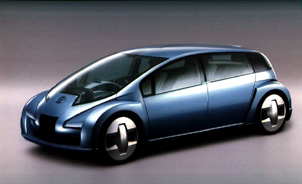
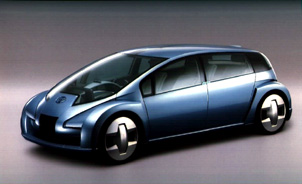
Fine-N
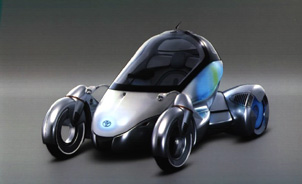
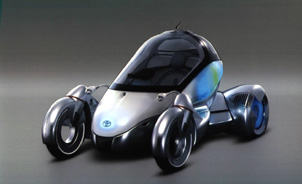
PM
| Vehicle type | Name | Length | Width | Height | Seating |
| FCHV | Fine-N | 4,355 | 1,820 | 1,495 | 4 |
| Gasoline-electric hybrid vehicle |
CS&S | 3,940 | 1,800 | 1,120 | 4 |
| SU-HV1 | 4,750 | 1,845 | 1,630 | 5 | |
| Electric vehicle | PM | 1,750-2,650 | 1,465 | 1,215-1,855 | 1 |
| Gasoline vehicle | NLSV | 3,970 | 1,690 | 1,710 | 5 |
| CROWN CONCEPT | 4,840 | 1,780 | 1,470 | 5 |
*1General public days; *2Fuel cell INnovative Emotion-Next generation; *3Compact Sport & Specialty; *4Sports Utility-Hybrid Vehicle 1; *5Personal Mobility with visual communication system; *6New-Life Support Vehicle; *7Formula 1 (FIA Formula One World Championship); *8Indy Racing League IndyCar Series
Fine-N
A fuel cell hybrid vehicle meant to shape the future of motoring, the Fine-N features radical styling in a novel package and 4WD using four in-wheel motors to achieve new dimensions in driving performance together with epoch-making environmental performance.
- Long cabin with futuristic styling: Fuel cell hybrid technology permits great freedom in power train layout, allowing the wheels to be positioned nearly at the four corners of the vehicle. Together with a long wheelbase, this results in a long cabin that offers a new experience in driving comfort and convenience, including a control interface that guides the driver with sight and sound.
- New dimensions in driving performance: This new package fits heavy components, such as the fuel cell stack, power control unit and battery, in low, central positions to lower the center of gravity and minimize yaw moment of inertia.
- Four-wheel in-wheel motor system with by-wire control: Mounted on the inner side of each wheel is a compact, lightweight, high-efficiency electric motor. Each of the four individual motors is rated at 25kW peak power and 110n-m peak torque. Each motor's drive power and braking is individually and continuously controlled by drive-by-wire technology to provide optimized wheel-by-wheel acceleration/deceleration and steering control according to steering angle, vehicle and road conditions and other parameters.
- Toyota FC Stack fuel-cell technology: The four in-wheel motors are driven by electric power supplied by the Toyota FC Stack and a lithium-ion battery. Raised fuel-cell efficiency and increased hydrogen tank pressure give the Fine-N a cruising distance of 500km.
- Biometric security and personalization system: Using biometric face-recognition technology, this system authenticates drivers to provide enhanced security and then personalizes seat position, audio system, climate control and other settings automatically.
CS&S
With its midship-mounted next-generation Toyota Hybrid System THS II* based on the Hybrid Synergy Drive concept and an E-Four (electric 4-wheel drive) system, the CS&S is designed to provide outstanding environmental performance and driving exhilaration.
- Outstanding driving performance: The next-generation hybrid system combines a 1.5-liter gasoline engine and 50kW high-output motor for powerful acceleration. Four-wheel control provided by the E-Four system and the midship positioning of the hybrid power plant further enhance handling and road-holding performance.
- Alluring styling: The simple and geometric design's two-seater canopy lines flow naturally into wheel arches that anticipate the 4WD system's powerful performance. Contrasting curves and sharp angles complement short, wide and low-slung proportions.
- Simple & sporty interior: Linked to the exterior design, a horseshoe motif defines individual spaces for driver and passenger, emphasizing a sporty drive feel.
- Sliding-canopy 2+2 seater: Rear seats can be made available by sliding back the canopy. The front seat-backs can be pushed all the way forward to secure the car.
- Space Touch control interface: The driver "touches" a spherical holographic interface for natural, effortless control.
SU-HV1
The SU-HV1 features an SUV-optimized Hybrid Synergy Drive and E-Four to deliver a new kind of powerful SUV performance together with compact-car-class fuel economy.
- Powerful new SUV-optimized hybrid system: The hybrid system power unit comprises a 3.3-liter V6 gasoline engine together with a 120kW motor. By raising the electrical system voltage and using a faster spinning motor and generator, Toyota has achieved higher output and torque for optimum pairing with the V6 engine. To configure the E-Four system, Toyota added a 50kW rear motor, which also achieves higher output and torque as a benefit of the more powerful electrical system. The result is awesome power.
- Environmental performance of a compact car: This application of Hybrid Synergy Drive gives the Toyota Hybrid SUV V8-level performance with fuel efficiency and emissions at compact car levels, twice as good as those of an SUV of equal displacement.
- Advanced Vehicle Dynamics Management (VDM): The VDM concept for next-generation vehicle movement control coordinates the hybrid system, E-Four and Electronically Controlled Brake System (ECB) for dramatically improved handling and road-holding stability.
PM
Designed to "meet, link and hang out," the PM is a "wearable" single-person vehicle that targets driver-vehicle unity and offers advanced vehicle-to-vehicle communication.
- Driver-vehicle unity with ergonomic focus: Cabin and seat shape are designed to fit almost like a glove, while integrating the driver's intention with the car's capabilities.
- Variable "lifelike" posture: The cabin and wheel-suspension structure are separated, allowing the PM to vary its posture according to speed and to facilitate entry and exit. Antennae-like headlamps contribute to the image of an exotic life form.
- Space input display: A floating virtual display senses driver finger position and shows vehicle data, locations of other PMs and other information.
- Vehicle-to-vehicle communication: PMs can share information as they travel, follow a leader in platoon formation and rendezvous automatically.
- A further evolution of the PM concept called the "i-unit" will be featured at the Toyota Group Pavilion at EXPO 2005 AICHI, to be held in Aichi Prefecture, Japan, beginning March 25, 2005.
NLSV
The NLSV features a large electric sliding door, low floor and high ceiling, in an application of universal design for increased usability by all.
- 1.26 square-meter door: Taller and wider than the door on the Toyota Alphard minivan, this remote-control-operated door permits walk-in access, along with 30cm ground clearance, low enough for easy entry/exit by small children.
- Flat floor and flexible seating: Seats can be rearranged to carry large items such as bicycles with their front wheels attached.
- Cool, modern styling: A solid looking low-slung body, arched cabin and large expanses of glass give the NLSV a distinctively contemporary look.
- 1.4-meter interior height: The cabin ceiling provides headroom that would be surprising even in a minivan. With its flat floor, two-color fabric surfaces, and other details, the interior is almost a living room on wheels.
CROWN CONCEPT
Innovative styling and extraordinary performance combine in the all-new CROWN CONCEPT that takes concepts of Japanese hospitality to the international stage, creating a new vision of composed yet dynamic luxury.
- Rhythmically elegant exterior: Powerful low-to-the ground elegance resonates with the brush-stroke rhythms of Japanese calligraphy. The roof meets the rear quarter panel in a distinctive flourish.
- Interior ambience of premium hospitality: The voluminous cabin welcomes driver and passengers with tasteful luxury and amenities.
- New 3.3-liter V6 D-4 engine and 6-speed automatic transmission: The newly developed engine and transmission deliver a world-class combination of dynamic power over the full speed range and outstanding fuel economy.
- Extensive safety features: Safety technology includes vehicle-movement control based on the concept of VDM, a pre-crash safety system, lane-keeping assistance function, radar cruise control, adaptive front-lighting system (AFS) and structural optimization for superior collision safety and minimized pedestrian injury.
Toyota TF103
The TF103 racecar competed in all 16 F1 races in 2003 ― Toyota's second year of F1 competition and dubbed by Toyota as its "Year of Challenge". The TF103 featured enhanced driving performance due to the combination of a high-output and reliable RVX-03 engine and seven-speed gearbox.
"Indy 500 Winner"
Gil de Ferran of Marlboro Team Penske drove this car to win the Indy 500. Toyota supplied the Toyota Indy RV8I engine to five IRL teams and won the 2003 Engine Manufacturer's title.
Environment
Next-generation fuel-cell technology: Fine-N
Next-generation hybrid technology: New Prius and SU-HV2
Commercialized fuel-cell technology: Toyota FCHV
Power train technology: CROWN CONCEPT power train ― new 3.0-liter V6 stoichiometric D-4 (internal direct injection) with VVT-i (Variable Valve Timing with intelligence) and six-speed automatic transmission (Sequential Shiftmatic)
Recycling technology: Toyota Eco-Plastic and enhanced dismantling
Safety
Active safety: Peripheral monitor system
Passive safety: Pre-crash Safety system
IT/ITS
New network service: G-BOOK
| - Alphard Hybrid |  |
- Corolla Spacio | |
- RAV4 L |
| - Avensis | - Estima Hybrid | - Sienta | ||
| - bB | - Ipsum | - Soarer | ||
| - Caldina | - MR-S | - Vitz (by Modellista) | ||
| - Celica | - Prius | - Wish (by Modellista) | ||
| - Corolla Fielder | - Raum |
- Alphard G (Welcab with wheelchair, Type 1)
- Estima T (Welcab Side Lift-up Seat model, standard type)
- Raum (Welcab Lift-up Front Passenger Seat model, Type B)
- Sienta (Welcab with wheelchair, Type 1)
Press Briefing
TMC will brief the press on Oct. 22*, beginning at 15:00 at the Toyota booth.
*Oct. 22 and Oct. 23 are press days.
 TOYOTA BOOTH & LEXUS BOOTH SPECIAL SITES