Jul. 08, 2003


EXPO 2005 Aichi, Japan to Feature Futuristic Transit Systems
―IMTS and Fuel Cell Hybrid Buses to Provide On-site Transportation―
Tokyo―The Japan Association for the 2005 World Exposition (the Association) and Toyota Motor Corporation (TMC) announced today that they have agreed on a joint project to provide on-site transportation for the 2005 World Exposition, Aichi, Japan (EXPO 2005 Aichi, Japan)*1 using advanced transportation technologies.
The movement of visitors within EXPO 2005 Aichi, Japan's Nagakute area*2 will be facilitated by TMC's IMTS (Intelligent Multimode Transit System), which features non-mechanically linked vehicles moving in platoon formation. Meanwhile, hydrogen-powered fuel cell hybrid buses developed by TMC will aid movement between the Nagakute and Seto areas.
Under the agreement, TMC, as a technical partner, will develop and supply the needed vehicles, while the Association will be in charge of developing the related infrastructure and of system operation and management. As this project will involve the first full-scale mass-transport operation of the rail-less but train-like IMTS, the Association has already obtained the required railroad operation permission from the Japanese government.
As the aim of EXPO 2005 Aichi, Japan is to propose a new global society model for the 21st century, the Association had been studying a variety of futuristic, eco-friendly transit systems that would be safe, comfortable and capable of turning simple transportation into a pleasant experience. TMC, meanwhile, had been looking for a way to offer many people firsthand experience of the convenience of IMTS as a next-generation urban transit system and of the efficiency and potential of fuel cell vehicles. After both sides confirmed their similar intentions, they agreed to use IMTS and fuel cell hybrid buses at the exposition.
With work underway by Aichi Rapid Transit Co., Ltd. to initiate Japan's first magnetically levitated linear motor car service (High Speed Surface Transport, or HSST, popularly known as "Linimo") as a means of access to the Nagakute area, the use of IMTS and fuel cell hybrid buses will enable EXPO 2005 Aichi, Japan visitors to experience futuristic mass transit systems traveling to, between and within the event's exhibition areas.
IMTS
IMTS is a new transit system based on the latest ITS (Intelligent Transport System) technology that allows the unmanned, automatic and platoon operation (in which multiple units run in file formation at unified speeds) of buses on dedicated roads, as well as manual and independent operation on ordinary roads. The system features the punctuality, high speed and large passenger capacity of conventional rail-based mass transit systems such as trains and the economic efficiency and flexibility of buses serving regular routes.
Fuel cell hybrid bus
The fuel cell hybrid bus operates on motors powered by high-pressure hydrogen-supplied fuel cells and a nickel-metal hydride secondary battery. Unlike gasoline- and diesel-fueled vehicles, it does not emit carbon dioxide or other toxic substances during operation and is highly energy-efficient, as well as quiet.
For overviews and operational details of the IMTS and fuel cell hybrid buses to operate at EXPO 2005 Aichi, Japan, please see Attachment 1 and Attachment 2.
*1 From March 25 to Sept. 25, 2005 in Aichi Prefecture.
*2 EXPO 2005 Aichi, Japan will comprise two exhibition areas―one in Nagakute Town and part of neighboring Toyota City and the other in Seto City.
The movement of visitors within EXPO 2005 Aichi, Japan's Nagakute area*2 will be facilitated by TMC's IMTS (Intelligent Multimode Transit System), which features non-mechanically linked vehicles moving in platoon formation. Meanwhile, hydrogen-powered fuel cell hybrid buses developed by TMC will aid movement between the Nagakute and Seto areas.
Under the agreement, TMC, as a technical partner, will develop and supply the needed vehicles, while the Association will be in charge of developing the related infrastructure and of system operation and management. As this project will involve the first full-scale mass-transport operation of the rail-less but train-like IMTS, the Association has already obtained the required railroad operation permission from the Japanese government.
As the aim of EXPO 2005 Aichi, Japan is to propose a new global society model for the 21st century, the Association had been studying a variety of futuristic, eco-friendly transit systems that would be safe, comfortable and capable of turning simple transportation into a pleasant experience. TMC, meanwhile, had been looking for a way to offer many people firsthand experience of the convenience of IMTS as a next-generation urban transit system and of the efficiency and potential of fuel cell vehicles. After both sides confirmed their similar intentions, they agreed to use IMTS and fuel cell hybrid buses at the exposition.
With work underway by Aichi Rapid Transit Co., Ltd. to initiate Japan's first magnetically levitated linear motor car service (High Speed Surface Transport, or HSST, popularly known as "Linimo") as a means of access to the Nagakute area, the use of IMTS and fuel cell hybrid buses will enable EXPO 2005 Aichi, Japan visitors to experience futuristic mass transit systems traveling to, between and within the event's exhibition areas.
IMTS
IMTS is a new transit system based on the latest ITS (Intelligent Transport System) technology that allows the unmanned, automatic and platoon operation (in which multiple units run in file formation at unified speeds) of buses on dedicated roads, as well as manual and independent operation on ordinary roads. The system features the punctuality, high speed and large passenger capacity of conventional rail-based mass transit systems such as trains and the economic efficiency and flexibility of buses serving regular routes.
Fuel cell hybrid bus
The fuel cell hybrid bus operates on motors powered by high-pressure hydrogen-supplied fuel cells and a nickel-metal hydride secondary battery. Unlike gasoline- and diesel-fueled vehicles, it does not emit carbon dioxide or other toxic substances during operation and is highly energy-efficient, as well as quiet.
For overviews and operational details of the IMTS and fuel cell hybrid buses to operate at EXPO 2005 Aichi, Japan, please see Attachment 1 and Attachment 2.
*1 From March 25 to Sept. 25, 2005 in Aichi Prefecture.
*2 EXPO 2005 Aichi, Japan will comprise two exhibition areas―one in Nagakute Town and part of neighboring Toyota City and the other in Seto City.
Attachment 1
IMTS (Intelligent Multimode Transit System)
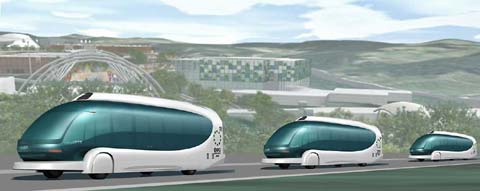
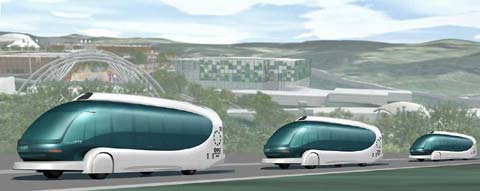
An artist's rendering of IMTS in platoon operation at EXPO 2005 Aichi, Japan
An artist's rendering of IMTS in platoon operation at EXPO 2005 Aichi, Japan
| Overview The next-generation transportation system IMTS features the following advantages:
Technical features IMTS vehicles are navigated and controlled by magnetic markers imbedded in the middle of their dedicated roads. A thorough fail-safe system is adopted, featuring automatic speed regulation and braking functions assured by inter-vehicle communication, ground signals and other means.
At EXPO 2005 Aichi, Japan At EXPO 2005 Aichi, Japan, IMTS will have the following characteristics:
Planned operation is as follows:
|
ATTACHMENT 2
Overview
The fuel cell hybrid buses to be used at EXPO 2005 Aichi, Japan will represent an improved version of the FCHV-BUS2―a large low-floor commuter bus that features a hybrid system powered by high-pressure hydrogen and that TMC and Hino Motors, Ltd. have been jointly developing since 2000.
The FCHV-BUS2, equipped with two units of TMC's high-performance Toyota FC Stack and incorporating the hybrid technologies found in the Toyota Prius hybrid passenger sedan and Hino's HIMR System, achieves high running efficiency by recovering energy during deceleration and delicately alternating between its fuel cells and secondary battery for power supply to the motor according to running conditions.
The FCHV-BUS2 was the first fuel cell-powered bus officially approved by Japan's Ministry of Land, Infrastructure and Transportation. Issued a license plate in 2002, the vehicle has been carrying out trial runs on public roads. It is also expected to run on regular Tokyo metropolitan bus routes this summer as part of a fuel cell bus pilot project promoted by the Tokyo Metropolitan Government.
Fuel Cell Hybrid Bus
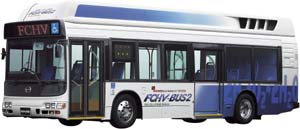
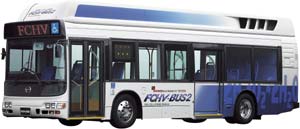
The FCHV-BUS2 fuel cell hybrid bus
(An improved version is due to operate at EXPO 2005 Aichi, Japan.)
The FCHV-BUS2 fuel cell hybrid bus
(An improved version is due to operate at EXPO 2005 Aichi, Japan.)
Overview
The fuel cell hybrid buses to be used at EXPO 2005 Aichi, Japan will represent an improved version of the FCHV-BUS2―a large low-floor commuter bus that features a hybrid system powered by high-pressure hydrogen and that TMC and Hino Motors, Ltd. have been jointly developing since 2000.
The FCHV-BUS2, equipped with two units of TMC's high-performance Toyota FC Stack and incorporating the hybrid technologies found in the Toyota Prius hybrid passenger sedan and Hino's HIMR System, achieves high running efficiency by recovering energy during deceleration and delicately alternating between its fuel cells and secondary battery for power supply to the motor according to running conditions.
The FCHV-BUS2 was the first fuel cell-powered bus officially approved by Japan's Ministry of Land, Infrastructure and Transportation. Issued a license plate in 2002, the vehicle has been carrying out trial runs on public roads. It is also expected to run on regular Tokyo metropolitan bus routes this summer as part of a fuel cell bus pilot project promoted by the Tokyo Metropolitan Government.
Technical features
As explained above, the fuel cell buses that will operate at EXPO 2005 Aichi, Japan will represent an improved version of the FCHV-BUS2. The main specifications of the current FCHV-BUS2 are as follows:
As explained above, the fuel cell buses that will operate at EXPO 2005 Aichi, Japan will represent an improved version of the FCHV-BUS2. The main specifications of the current FCHV-BUS2 are as follows:
| Vehicle | Base platform | Blue Ribbon City (Hino low-floor commuter bus) |
| Overall length / width / height | 10,515 / 2,490 / 3,360 mm | |
| Maximum speed | 80 km/h | |
| Occupant capacity | 60 people | |
| Fuel cell stack | Type | Polymer electrolyte fuel cell |
| Output | 90 kW x 2 | |
| Motor | Type | Permanent magnet |
| Maximum output | 80 kW x 2 | |
| Maximum torque | 260 Nm x 2 | |
| Fuel | Type | Pure hydrogen |
| Storage method | High-pressure hydrogen storage tank | |
| Maximum storage pressure | 35 MPa (350 atmospheres) | |
| Secondary battery | Type | Nickel-metal hydride |
At EXPO 2005 Aichi, Japan
At EXPO 2005 Aichi, Japan, the improved fuel cell hybrid buses will operate as follows:
At EXPO 2005 Aichi, Japan, the improved fuel cell hybrid buses will operate as follows:
- Period: March 25 - Sept. 25, 2003 (185 days)
- Hours: 9 a.m. - 6 p.m. (tentative)
- Service area: Between the Nagakute and Seto areas (about 3.5 km)
- Traveling time: about 10 minutes (one way)
- Departure intervals: Every 6 - 8 minutes
- Passenger capacity: Approximately 900 - 1,200 passengers/hour, round-trip