Apr. 02, 2004


Chinese Reforestation Project Gets 3-year Extension
Beijing ― The China-Japan Scientific Technology & Economic Exchange Association of the Chinese Academy of Sciences, the Hebei Province Forestry Bureau, NPO Green Earth Center and Toyota Motor Corporation (TMC) announced today that they have agreed to extend for three years a reforestation project designed to limit desertification in China. This project, which was initiated as a three-year joint reforestation project in April 2001 as part of TMC’s social contribution program, involves planting trees in Fengning Man Autonomous County, Hebei Province. A new agreement for the project’s second term was signed in Beijing on April 2, 2004, following a report earlier in the day on the results of the reforestation project’s first three years.
The actual tree planting during the first term of the project was overseen by the Fengning Man Autonomous County Forestry Bureau and involved local residents planting poplar, pine, wild apricot and herbaceous plants on a total of 1,500 hectares over the course of three years. TMC provided the necessary funds for the reforestation, and together with the Chinese Academy of Sciences, monitored the resulting restoration of the environment and undertook the selection of drought-resistant tree species. TMC also conducted investigations into pasture management as a measure to combat overgrazing, the principle cause of desertification, and initiated the cultivation of medicinal plants in an effort to help the area achieve economic independence. The NPO Green Earth Center sent a considerable number of volunteers from Japan to Fengning Man Autonomous County to engage in the tree planting, advancing volunteer exchanges between Japan and China.
The project’s second term, which will begin this month, builds on the results of the first three years and will be more comprehensive. A further 1,000 hectares is scheduled for reforestation, while at the same time emphasis will be placed on creating mechanisms to ensure that restored land will not revert to desert, in the hope that the area will eventually be able to independently manage its reforestation program. The project will focus in particular on pasture management and fruit tree propagation.
Furthermore, in an effort to improve people’s reforestation skills and advance volunteer exchanges and information sharing, TMC will promote the establishment of a base for local activities.
| Project name | Second Sino-Japanese Joint “21st Century Greater Beijing Reforestation Model” Initiative |
| Participating parties | China-Japan Scientific Technology & Economic Exchange Association, Chinese Academy of Sciences; Hebei Province Forestry Bureau; NPO Green Earth Center; Toyota Motor Corporation |
| Project term | April 2004 – March 2007 |
| Location | Fengning Man Autonomous County, Hebei Province |
| Funding | 150 million yen (50 million yen per year) |
| 1st term | 2nd term (planned) | ||
| Project term | April 2001 – March 2004 | April 2004 – March 2007 | |
| Reforestation area | 1,500 ha | 1,000 ha | |
| Funding | 150 million yen | 150 million yen | |
| Joint research | Environmental restoration monitoring | (Both terms) Continual monitoring of the proportion of vegetative coverage and the surrounding environment (weather conditions, amount of airborne sand, groundwater level, soil conditions, etc.), in order to gain an understanding of the transition from a desert to a vegetative state. A reduction in the amount of airborne sand and a halt to rising ground temperatures were observed during the course of the first term. |
|
| Selection of drought-resistant tree species | (Both terms) Investigation and subsequent application to the reforestation area of the following: Selection of drought-resistant tree species that can survive in a semi-arid environment; Use of moisture retaining agents; Effective methods of vegetative cover to encourage ecosystem restoration. |
||
| Investigation of pasture management | (Both terms) Investigation of appropriate pasture management methods to combat overgrazing, one of the causes of desertification, and implementation of such methods together with local residents. |
||
| Economic independence through cultivation of medicinal plants and fruit trees | (Principally 2nd term) Support for the creation of mechanisms to promote economic independence and sustainable development following the halting of desertification and restoration of the environment. Establishment of propagation methods with a view to increasing the yield and quality of fruit and medicinal plants, followed by the creation of a propagation manual and encouraging its use by local residents. |
||
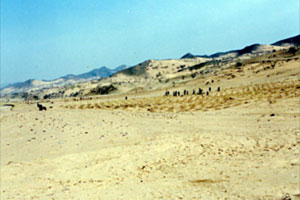
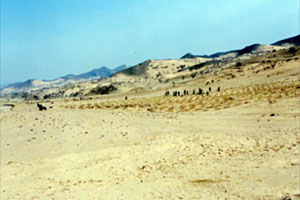
Tree planting (April 2001)

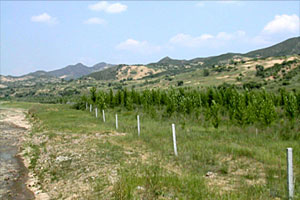
2 years and 3 months after planting
completed (July 2003)