Jul. 26, 2005


Lexus Unveils GS, SC and IS Vehicle Series for Japan
New Models to Kick Off Domestic Sales on August 30
Tokyo, July 26, 2005
― Lexus unveiled today the new GS*1 and SC*2 vehicle series models, which will be sold in Japan when Lexus begins domestic operations on August 30. It also unveiled the IS*3 vehicle series, which will begin sales on September 28.
The Lexus brand was launched in North America in 1989, and operations were subsequently expanded to Europe and Asia. With the commencement of operations in Japan, Lexus will continue its "pursuit of the essence of luxury" and will seek to establish a global premium brand that can respond to a growing customer segment that places particular importance on "individuality" and a "sense of the best".
To Lexus, the "pursuit of the essence of luxury"―the core principle of the Lexus brand―means providing the highest-quality products and an unparalleled purchasing and after-sales service experience, as well as superior excitement and comfort when driving in a Lexus vehicle. In order to achieve this, Lexus continues to make uncompromising efforts in all aspects of development, production and sales.
In product development, Lexus employs its original design philosophy of L-finesse*4, and all Lexus vehicles share the five development concepts, including "advanced", that form the I.D.E.A.L.*5 values.
In order to realize this, Lexus has adopted more than 500 unique product quality standards, known as Lexus MUSTs, regarding all development aspects, from quantitative performance to the actual experience of quality, in the pursuit of 1) the exceptional product strength becoming of a premium brand, 2) consistency within the Lexus brand and 3) individual appeal in each vehicle.
The new vehicles have been designed based on these concepts. The GS seeks to provide not only exceptional driving performance but also new, premium value in every aspect. The SC pursues the epitome of beauty with "the jewel of Lexus" as its theme. Meanwhile, the IS focuses on "impressive and comfortable driving", and pursues the ideal package to achieve this.
The Lexus brand was launched in North America in 1989, and operations were subsequently expanded to Europe and Asia. With the commencement of operations in Japan, Lexus will continue its "pursuit of the essence of luxury" and will seek to establish a global premium brand that can respond to a growing customer segment that places particular importance on "individuality" and a "sense of the best".
To Lexus, the "pursuit of the essence of luxury"―the core principle of the Lexus brand―means providing the highest-quality products and an unparalleled purchasing and after-sales service experience, as well as superior excitement and comfort when driving in a Lexus vehicle. In order to achieve this, Lexus continues to make uncompromising efforts in all aspects of development, production and sales.
In product development, Lexus employs its original design philosophy of L-finesse*4, and all Lexus vehicles share the five development concepts, including "advanced", that form the I.D.E.A.L.*5 values.
In order to realize this, Lexus has adopted more than 500 unique product quality standards, known as Lexus MUSTs, regarding all development aspects, from quantitative performance to the actual experience of quality, in the pursuit of 1) the exceptional product strength becoming of a premium brand, 2) consistency within the Lexus brand and 3) individual appeal in each vehicle.
The new vehicles have been designed based on these concepts. The GS seeks to provide not only exceptional driving performance but also new, premium value in every aspect. The SC pursues the epitome of beauty with "the jewel of Lexus" as its theme. Meanwhile, the IS focuses on "impressive and comfortable driving", and pursues the ideal package to achieve this.
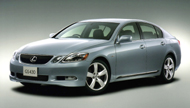
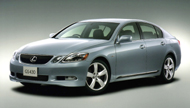
GS430 (with options)
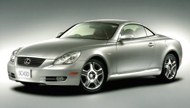
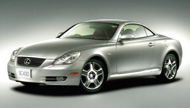
SC430 (with options)
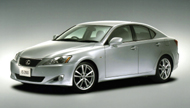
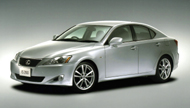
IS350 (with options)
The GS450h, a GS with a hybrid system, will be released in the spring of 2006, and the LS, Lexus' flagship sedan, will be introduced later that year.
Sales and service will be conducted through a Lexus specialty dealer network of 143 dealers, as of August 30, and 151 dealers by year-end. Dealer outlets feature a uniform design and are staffed by approximately 2,000 employees, collectively. All employees have undergone specialized Lexus training―through the Lexus Total Care system and other exclusive programs designed to make the purchase and ownership of Lexus vehicles the best possible experience―to provide hospitality and customer satisfaction that exceeds expectations in all phases, from consulting to vehicle delivery and maintenance.
*1 Grand Sedan
*2 Sports Coupe
*3 Intelligent Sports Sedan
*4 L-finesse: created by combining "leading-edge" and "finesse" design concepts
*5 Created from the first letters of "impressive", "dynamic", "elegant", "advanced" and "lasting"
Note: Products described in this and in any attached material are for the Japanese market only
Sales Outline
1. Sales Channels
Sales Outlets: "LEXUS" dealers nationwide
2. Sales Start:
| GS/SC: | August 30, 2005 |
| IS: | September 28, 2005 |
3. Monthly Sales Targets:
| GS: | 1,100 units |
| SC: | 100 units |
| IS: | 1,800 units |
4. Dealer Launch Events:
"LEXUS DEBUT EXPO" August 30 to September 11, 2005
"IS DEBUT SHOW" September 28 to October 2 , 2005
Assembly Plants
GS: Tahara Plant, Toyota Motor Corporation
SC: Higashi Fuji Plant, Toyota Motor Corporation
IS: Tahara Plant, Toyota Motor Corporation; Miyata Plant, Toyota Motor Kyushu, Inc.
Manufacturer's Suggested Retail Prices
| (Unit: yen) |
| Model and Trim Level | Engine | Power Train | Transmission | Price*1,*2(Including Consumption Tax) | |
| GS430 | 3UZ-FE 4.3-liter V8 |
Front-engine, rear-wheel drive | 6SuperECT*4 | 6,300,000 | |
| GS 350 | 2GR-FSE 3.5-liter V6 |
5,200,000 | |||
| AWD*3 | 5,600,000 | ||||
| SC430 | 3UZ-FE 4.3-liter V8 |
Front-engine, rear-wheel drive | 6,800,000 | ||
| 2GR-FSE 3.5-liter V6 |
4,800,000 | ||||
| IS350 | "version L" | 5,250,000 | |||
| "version S" | 4,950,000 | ||||
| 4GR-FSE 2.5-liter V6 |
3,900,000 | ||||
| "version L" | 4,350,000 | ||||
| IS250 | "version S" | 4,050,000 | |||
| AWD | 4,250,000 | ||||
| "version L" | 4,700,000 | ||||
*1 In Hokkaido, plus 18,900 yen for the GS430, plus 25,200 yen for the GS350, plus 1,050 yen for the SC430 and plus 23,100 yen for the IS350/IS250
*2 Prices listed do not include recycling fees
*3 All–wheel drive
*4 Super Intelligent Six-speed Automatic Transmission
*2 Prices listed do not include recycling fees
*3 All–wheel drive
*4 Super Intelligent Six-speed Automatic Transmission
Vehicle Dimensions
| (Unit: millimeters) |
| Model | Length | Width | Height | Wheel base |
| GS430/GS350 | 4,830 | 1,820 | 1,425*1 | 2,850 |
| SC430 | 4,535 | 1,825 | 1,355 | 2,620 |
| IS350/IS250 | 4,575 | 1,795 | 1,430*2 | 2,730 |
* 1 The height is 1,435 for AWD versions.
* 2 For front-engine, rear-wheel-drive versions with 17-inch wheels and for front-engine, rear-wheel-drive versions with 18-inch wheels, the height is 1,435 mm. The height is 1,445 for AWD versions.
Vehicle Outline
GS Vehicle Series
With a design based on L-finesse
SC Vehicle Series
With a design based on L-finesse
With a design based on L-finesse
*2 Fuel efficiency standards specified by the Law Concerning the Rational Use of Energy
* 2 For front-engine, rear-wheel-drive versions with 17-inch wheels and for front-engine, rear-wheel-drive versions with 18-inch wheels, the height is 1,435 mm. The height is 1,445 for AWD versions.
Vehicle Outline
GS Vehicle Series
With a design based on L-finesse
- Unique, long-cabin proportions and contrasting shapes come together to create a dynamic, yet elegant, exterior.
- The interior is formed by a clear sense of hospitality, as well as by shapes that are simple, yet full of depth.
- The 4.3-liter V8 3UZ-FE engine offers high torque and a truly refined driving sense that only a V8 can provide.
- The new 3.5-liter V6 2GR-FSE engine combines outstanding driving performance with excellent fuel efficiency and low emissions.
- The 6SuperECT and Sequential Shiftmatic offers smooth gear shifting and sporty operation.
- The VGRS (Variable Gear Ratio Steering) dynamically varies the relationship between the amount the steering wheel is turned and the angle of the front wheels (standard on the GS430).
- An electric active stabilizer suspension system, the first in the world*1, contributes to a smooth ride and stable turning performance (optional on the GS430).
- The highly reassuring brake system provides solid stopping power, precise control and a sense of firmness.
- A lane-keeping assist system (optional on the GS430) and radar cruise control (optional on all vehicles in the series) lends itself to safe driving.
- The advanced-function, G-Link-compatible HDD (Hard Disc Drive) navigation system includes a "sound library" that can hold up to 2,000 music titles.
- The cutting-edge, Lexus-dedicated telematics service, G-Link (compatible with HelpNet and G-Security) includes various new services, such as route planning with traffic congestion warnings.
- Going a step beyond an earlier VDIM (Vehicle Dynamics Integrated Management) system that provided integrated control of drive power, steering and braking, the newly developed VDIM is the first in the world*1 with integrated active steering control. The new VDIM integrates the active steering function for optimal control of the front-wheel steering angle through use of VGRS for a higher level of preventive safety and ideal vehicle performance (standard on the GS430).
- The Pre-Crash Safety system warns drivers that a front-end collision is imminent and works to reduce injury in such an event (an emergency brake-link type is standard; a millimeter-wave radar type is optional).
- Driver-Assist Braking Control, or DABC, the first in the world*1, aims to enhance driving safety and contributes to passive safety by controlling the brakes for gentle deceleration according to the speed of the vehicle ahead (optional on the GS430).
- All vehicles in the series have been certified as having emissions levels 75% lower than 2005 standards under the Ministry of Land, Infrastructure and Transport's Approval System for Low-emission Vehicles.
- Eco-VAS (Eco-Vehicle Assessment System), a unique environmental evaluation system developed by Toyota Motor Corporation, has been employed to reduce environmental impact, namely through the implementation of life cycle assessment (LCA), resulting in the reduction of emissions of CO2 and other atmospheric pollutants, not just during the use stage but also over the entire life cycle of the vehicle, from manufacture through to disposal.
SC Vehicle Series
With a design based on L-finesse
- With the roof up or down, the exterior is a statement of elegance, while the interior is an expression of brilliance.
- The 4.3-liter V8 3UZ-FE engine offers high torque and a truly refined driving sense that only a V8 can provide.
- The 6SuperECT and Sequential Shiftmatic offers smooth shifting and sporty operation.
- The brake system delivers the stable braking performance expected of a system that offers a truly natural brake pedal feel.
- Includes the cutting-edge, Lexus dedicated telematic service, G-LINK.
- All vehicles in the series have been certified as having emissions levels 75% lower than 2005 standards under the Ministry of Land, Infrastructure and Transport's Approval System for Low-emission Vehicles.
- LCA has been implemented and emissions of CO2 and other atmospheric pollutants have been reduced, not just during the use stage but also over the entire life cycle of the vehicle, from manufacture through to disposal.
With a design based on L-finesse
- The exterior is marked by a wide stance that indicates a high level of driving performance and the look of a condensed form packed with power.
- A sense of Japanese beauty imbues the interior, which was created out of a space characterized by overflowing affluence and depth.
- The new 3.5-liter V6 2GR-FSE engine combines outstanding driving performance with excellent fuel efficiency and low emissions.
- The 2.5-liter V6 4GR-FSE engine offers easy and balanced driving.
- The 6SuperECT and Sequential Shiftmatic (with steering paddle shift) offers smooth gear shifting and sporty operation for that added joy of complete control.
- The highly reassuring brake system provides solid stopping power, precise control and a sense of firmness.
- The radar cruise control contributes to superior driving comfort (optional on all vehicles in the series).
- The advanced-function, G-Link-compatible HDD (Hard Disc Drive) navigation system includes a "sound library" that can hold up to 2,000 music titles.
- The cutting-edge, Lexus-dedicated telematics service, G-Link (compatible with HelpNet and G-Security) includes various new services, such as route planning with traffic congestion warnings.
- The VDIM integrates a higher level of preventive safety and ideal vehicle performance (standard on the IS350).
- The Pre-Crash Safety system warns drivers that a front-end collision is imminent and works to reduce injury in such an event (a millimeter-wave radar type is optional on all vehicles in the series).
- The world's first*1 SRS (Supplemental Restraint System) Twin-Chamber Airbag comprises two chambers that, upon deployment, form a depression in the center in order to secure the passenger's upper body, particularly the shoulders and head, from various angles in an effort to disperse the physical impact felt by the passenger and minimize injury.
- All vehicles in the series have been certified as having emissions levels 75% lower than 2005 standards under the Ministry of Land, Infrastructure and Transport's Approval System for Low-emission Vehicles. IS250 rear-wheel drive vehicles boast fuel efficiency that is five percent lower than the level called for by Japanese 2010 fuel efficiency standards*2, while the IS250 all-wheel-drive vehicles efficiently meet these fuel efficiency standards.
- Eco-VAS, a unique environmental evaluation system developed by Toyota Motor Corporation, has been employed to reduce environmental impact, namely through the implementation of LCA, resulting in the reduction of emissions of CO2 and other atmospheric pollutants, not just during the use stage but also over the entire life cycle of the vehicle, from manufacture through to disposal.
*2 Fuel efficiency standards specified by the Law Concerning the Rational Use of Energy