Jan. 22, 1974


TOYOTA BEGINS SELLING EASS
Sales limited to the Tokyo area for the time being
TOKYO Toyota Motor Sales began initial sales of the Engine Automatic Stop and Start (EASS) System, on January 14, 1974. Sales will be limited to the Tokyo area for the time being.
EASS was developed to help reduce fuel consumption and the amount of harmful gases emitted while automobile engines are idling. In Tokyo and other large cities where traffic jams are common, cars spend a considerable amount of time standing still, (the density of carbon monoxide is greater when engines are idling), and the device is designed to automatically shut off an engine after a car has stopped and remained stopped with the engine running, for about 1.5 seconds.
In test drives around downtown Tokyo, Toyota proved that the system reduced the amount of carbon monoxide emitted by an engine by about 30%, and fuel consumption decreased 10-15%.
The EASS presently on sale can only be used with the Crown manual transmission, for 2000 cc, or 2600 cc, 6 cylinder engines, and is available only at Toyopet Dealers in the Tokyo area as optional equipment on new Crowns. The price, including installation and labor charge, is ¥59,000, and an initial 300-400 sets are expected to be sold.
Toyota has obtained patents for the system in the United States, West Germany, and France, and patents are applied for in Japan and Italy. Features of EASS are outlined on the attached sheet.
The EASS System
- Basic Operations
- Automatic Engine Shut-off
When the car stops and remains for about 1.5 seconds, the device shuts off the engine automatically. - Automatic Engine Re-start
The engine is automatically re-started by depressing the clutch pedal.
- Automatic Engine Shut-off
- Safety Features
- The engine will not stop in the following situations
- When stopped with the right turn signal indicator in operation (especially necessary when making right turns on Japanese roads).
- When stopped on an incline (up or down) of 2° or more.
- When the engine temperature exceeds 100°C.
- When a large amount of electricity is in use, (when head lamps, air conditioner, or de-fogger is turned on).
- EASS will not operate under the following conditions
- When the door to the driver's seat is open.
- When the battery voltage becomes lower than 7.5V.
- When starting the engine with the ignition switch.
- A warning buzzer will sound when a door is opened while the key is left in the ignition, to prevent locking the car with the key inside.
- The engine will not stop in the following situations
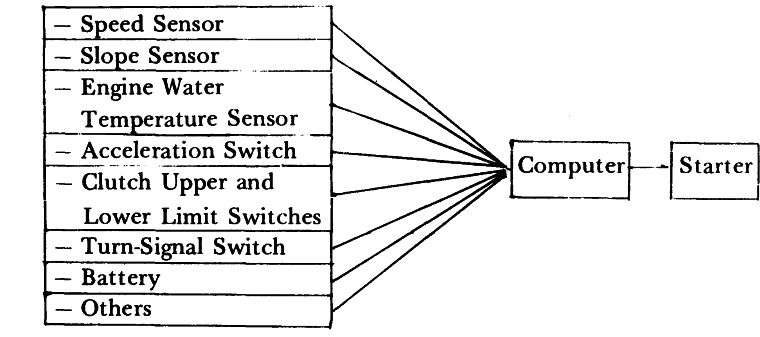
- Schematic Diagram of EASS
- Structure
- Sensors
- Computer
- Relays
- Operational Chart
- Structure