Jan. 23, 1975


"CAR ELECTRONICS"
CAPTURES THE IMAGINATION OF JAPAN'S AUTOMAKERS
Many New Devices Developed at Toyota have Contributed to Trend
TOKYO―The Japan automotive industry is swiftly creating a wide range of electronic components to take the place of many existing mechanical and electromagnetic parts now in use. The trend toward these new components and systems is, in fact, turning into a "Boom."
This strong movement toward "car electronics" is being reinforced by the accelerated development of many electronic devices designed to perform uniquely new functions.
One reason for the movement is the fast advancing status of the electronics industry itself. Another is the competitive desire to produce even better and more reliable cars. Adding impetus is the urgent need for advanced equipment to cope with stricter exhaust gas emission regulations.
The industry's remarkable advances in this field would best be illustrated by outlining the representative progress being made by the largest vehicle manufacturer in Japan―Toyota.
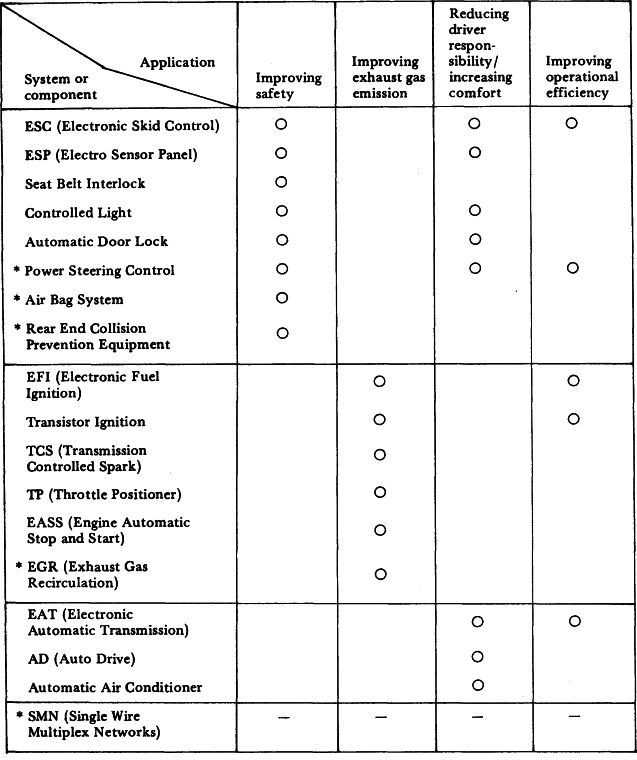
Toyota's pertinent development achievements and programs can be broken down into three major areas: (1) Electronics for safer vehicles, (2) Electronics for exhaust gas emission control, and (3) Electronics for more driving comfort.
ELECTRONICS FOR SAFER VEHICLES
In this first of three fields, Toyota's major developments are: ESC (Electronic Skid Control), ESP (Electro Sensor Panel) which automatically diagnoses all key vehicle functions), Seat Belt Interlock, Controlled Light (vehicle light control), an Air Bag System and a Rear Collision Protection Unit.
ESC (Electronic Skid Control). This stops the locking of rear wheels and prevents skidding. A speed sensor detects changes in rear wheel rotation and conveys this information through a "computer" to an actuator.
ESP (Electro Sensor Panel). This detects irregularities in safety-related components of the vehicle and monitors functions while underway. The computerized results are displayed on a panel mounted on the dashboard.
SEAT BELT INTERLOCK. The SBI will not allow the engine to start if seat belts are unfastened or improperly fastened.
CONTROLLED LIGHT. This device automatically controls "on" and "off" switching and brightness of headlights, tail lights and running lights, as well as beam direction switching of headlights.
AUTOMATIC DOOR LOCK. This functions to assure that doors are locked.
POWER STEERING CONTROL. This unit provides variable steering power in relation to vehicle speed and other factors.
AIR BAG SYSTEM. This reduces collision impact on passengers. A radar sensor detects obstacles before collision and automatically inflates an air bag cushion.
SMN (Single Wire Multiplex Network). This has helped improve "trouble-shooting" efforts and monitoring of all parts and components while in operation.
A number of the electronic devices and systems developed to date have been in connection with Toyota's widely publicized Experimental Safety Vehicle (ESV). Advanced electronics are essential in the ESV. Because of their successful use in the ESV. such items as the ESP and shock absorbing bumper are now being incorporated into production line vehicles.
ELECTRONICS FOR EXHAUST GAS EMISSION CONTROL
EFI (Electronic Fuel Ignition). This new computer-line device replaces conventional carburetors, supplying cylinders with the exact amount of fuel necessary to increase combustion efficiency and improve vehicular responsiveness.
TRANSISTOR IGNITION. This maintenance-free device improves ignition and fights air pollution by reducing the amount of HC and CO in exhaust gas.
TCS (Transmission Controlled Spark). This reduces NOx and, through improved oxidation, also reduces generation of HC.
TP (Throttle Positioner). This device provides improved control of the throttle in sudden stops and is also useful in reducing HC.
EASS (Engine Automatic Stop and Start). This unit saves fuel by stopping and starting the engine during idling periods and reduces air pollution.
EGR (Exhaust Gas Recirculation). This reduces the amount of NOx present by recirculating part of the exhaust gas to the air inlet side, while lowering maximum combustion temperature.
ELECTRONICS FOR MORE DRIVING COMFORT
EAT (Electronic Automatic Transmission). This "computer-controlled" automatic transmission provides more accurate shift performance than the also available manual range transmission.
AD (Auto Drive). This "computerizes" control of the accelerator pedal and provides safer and more accurate control of running speeds. To assure greater safety, the device is not activated during low-speed urban driving.
AUTOMATIC AIR CONDITIONER. This unit maintains temperature within a vehicle at a predetermined level, regardless of changes in outside temperature or volume of sunlight.
Other Toyota electronic systems and devices have been developed that cover several of the above 3 fields. One of these is the Toyota MAC (Multifunctional Automobile Communication) System. This helps to eliminate traffic congestion by informing individual drivers of the best routes to take to reach specific locations.
Electric Car. Another major development that involves a variety of electronic components is the company's electric car research project. In cooperation with the Ministry of International Trade and Industry, Toyota has carried out intensive research since 1971 with the goal of creating an efficient battery- operated passenger vehicle.
The project has been accelerated because of the desire to utilize alternate sources of motive power, reduce the size of cars to help solve traffic congestion, and eliminate vehicle-generated air pollution in urban areas. One prototype has already been engineered and another improved electric car will be revealed by the end of 1975.
An advanced thyristor chopper controlled DC compound motor has been developed for the electric car. Other specialty equipment being incorporated includes: (1) a hybrid electronic hydraulic brake, (2) "computer controlled" security circuits to enhance operational safety, (3) a unique power reserve battery gauge, (4) EAT―Electronic Automotive Transmission," and (5) a simplified "computer-monitored" charging control device.
During 1974, Toyota opened 2 new research laboratories and inaugurated a number of new research programs. Other vehicle manufacturers in Japan are, similarly, investing increasingly large amounts of time and money in research. Because "car electronics" offers one of the best approaches to solving problems related to exhaust gas emissions, fuel conservation and vehicle safety, it is evident that this trend will become more pronounced in 1975.
FACT SHEET
Selected electronic systems or devices
developed for use on Toyota vehicles