Nov. 04, 1994


THE TOYOTA FOUNDATION APPROVES 259 GRANTS
TOTALING ¥381 MILLION
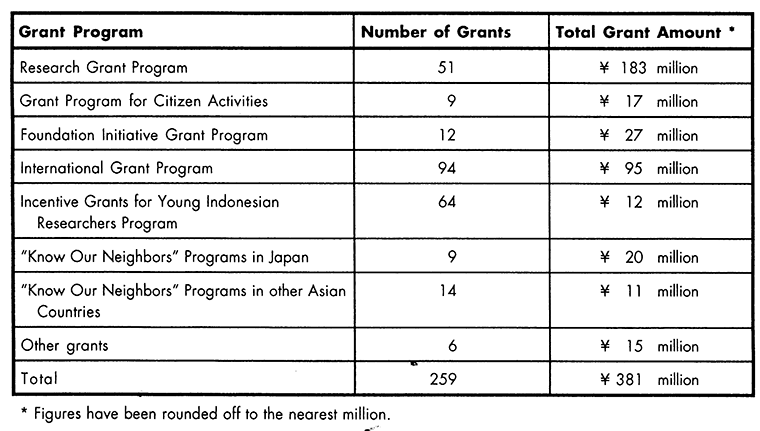
On September 22, 1994, the Toyota Foundation's Board of Directors, chaired by Eiji Toyoda, honorary chairman of Toyota Motor Corporation, approved 259 awards, worth a total of ¥381 million. The grant presentation ceremony was held on October 20, 1994, at the United Nations University in Tokyo. Also at this event, Toshitaka Hidaka, professor emeritus of Kyoto University, made a speech commemorating the 20th anniversary of the Toyota Foundation. Since fiscal 1975, when grant making activities were begun, the Foundation has approved 3,761 grants, worth a total of ¥9.2 billion. Total grants for fiscal 1994 are expected to reach ¥465 million. A breakdown of grants issued to date in fiscal 1994 is provided below.
- Research Grant Program
- Under the basic theme "Creating a Society with Pluralistic Values," grants were provided for research projects that covered one of the following topics
-
- Mutual understanding and coexistence of diverse cultures
- Proposals for a new social system: building a civil society
- The global environment and the potential for human survival
- Science and technology in the age of civil society
From a total of 788 grant applications, the Foundation awarded 51 grants, worth a total of ¥183 million. This fiscal year, the Foundation focused on research projects aimed at solving social problems. In addition, grant categories were divided into Type A Grants, which were aimed at independent-minded young researchers undertaking projects on their own, and Type B Grants, which especially targeted international joint research projects. Fiscal 1994 was also the first year in which we accepted applications in English. Despite this announcement, there were not many applications in English and grants were only awarded to two such projects. - Grant Program for Citizen ActivitiesReflecting changes in the environment surrounding citizen activities, we provided funding for citizen activities that aim to propose alternatives from the viewpoint of local community and new lifestyles under the theme "A New Look at Local Communities and Lifestyles." Applications are accepted and grants approved twice each fiscal year. In the first period of fiscal 1994, nine of the 1 17 applications were approved, totaling ¥17 million. Applications for the second period of fiscal 1994 will be accepted between October 15 through December 15.
- Foundation Initiative Grant ProgramUnder this program, grants are awarded to projects that do not fall within the scope of Foundation's existing programs, but are considered to be important for the Foundation's future plans. Such awards are not open to application. In fiscal 1994, 12 grants were awarded, worth a total of ¥27 million. A total of ¥40 million is budgeted for this program.
The above three programs are classified into four sections: 1) those related to cultural affairs, 2) projects concerning social systems, 3) those related to environmental matters and 4) those related to science and technology.
- Projects Related to Cultural Affairs
- Research Grant Program
-
- Type A Grants
- 14
-
- Type B Grants
- 8
-
-
- Foundation Initiative Grants
- 3
Examples of projects funded are listed below.- Cultural anthropological study of the social roles of religions in the immigrant cities of West Africa; continuity and change of ethnicity: a case study of the acceptance of a Japanese new religion in Cote d'Ivoire (Naoki Kashio, graduate student at the University of Tokyo;¥1.6 million; Type A Grant)
- Research concerning psychosocial stress occurring through the multinationalization of society and a model for the psychiatric support system for a multinational society with less stress: a case study of countries with high immigrant and refugee influxes (Norihiko Kuwayama, psychiatrist at Yamagata University, and six associates; ¥5.2 million; Type B Grant)
- Preservation of artifacts at Hue Art Museum, Vietnam, and preservation and restoration of the monuments of the Ming Mang Mausoleum (Thai Cong Nguyen, director of the Hue Monuments Conservation Center, Vietnam; ¥1.8 million; Foundation Initiative Grant)
- Research Grant Program
- Projects Concerning Social Systems
- Research Grant Program
-
- Type A Grants
- 7
-
- Type B Grants
- 8
-
-
- Citizen Activities Grants
- 5
-
- Foundation Initiative Grants
- 8
Examples of projects funded are listed below.- A study on NGOs' work in participatory development and democratization and northern aid agencies cofinancing: a case study of the CIDA's partnership programs in the Philippines and Indonesia (Akio Takayanagi, lecturer at Kitakyushu University; ¥1.5 million; Type A Grant)
- A comprehensive study on the prospects of development compatible with human rights in Thailand, with special reference to gender-based discrimination of labor (Seiko Hanochi,Secretary General of the East Asian Women's Forum, and 12 associates; ¥6 million; Type B Grant)
- The collection and dissemination of information on HIV sufferers in Japan (Yoji Inoue, representative of the Stay Healthy Information Project; ¥2 million; Citizen Activities Grant)
- Production of a private Japanese report for the 1995 UN Social Development Summit and NGO Forum (Jun Nishikawa of the Japanese Organizational Committee for NGO Forums at the Social Development Summit; ¥1.5 million; Foundation Initiative Grant)
- Research Grant Program
- Projects Related to Environmental Matters
- Research Grant Program
-
- Type A Grants
- 4
-
- Type B Grants
- 6
-
-
- Citizen Activities Grants
- 4
-
- Foundation Initiative Grants
- 1
Examples of projects funded are listed below.- Exploring indigenous natural products for resistance management/ control of storage pests of rice and corn (E. O. Owusu, a graduate student at Ehime University; ¥1.9 million; Type A Grant)
- International joint study of environmental issues towards the preparation of "The State of the Environment in Asia" (Toshiko Akiyama, professor at the Women's College, Aoyama Gakuin University, and 13 associates; ¥10 million; Type B Grant)
- Reconstruction of the local community following the flooding of the Kotsuki River in Kagoshima Prefecture: the use of stone bridges in disaster prevention (Toshitaka Ueno, representative of the Kagoshima Disaster Prevention Forum; ¥1.9 million; Citizen Activities Grant)
- Construction of a database on an inventory of all of the usable vegetation on the Indian subcontinent to facilitate the use of the inventory to aid in the sustainable development of global plant resources (Tetsuo Koyama of the Association for the Education of Staff for Research into the Plant Resources of Asia; ¥4.2 million; Foundation Initiative Grant)
- Research Grant Program
- Projects Related to Science and Technology
- Research Grant Program
-
- Type A Grants
- 1
-
- Type B Grants
- 1
Examples of projects funded are listed below.- The role of traditional medicine in present Sri Lankan society: a medical anthropology field research on ancient historical and medical scriptures and their effect on different ethnic and religious groups of society (Machiko Higuchi, a graduate student at the University of Colombo, Sri Lanka; ¥1.7 million; Type A Grant)
- Evolution of science and technology in Japan: building a database on major primary sources (Chikayoshi Kamatani, professor at Toyo University, and six associates; ¥4 million; Type B Grant)
-
- Research Grant Program
- International Grants awarded for projects aimed at preserving and encouraging indigenous cultures in Southeast AsiaInternational grants are awarded for research projects that respond to the needs of society in developing countries. At present, the program concentrates on projects conducted in Southeast Asian countries by indigenous researchers and aimed at preserving and encouraging indigenous cultures. In addition, the Foundation runs a subprogram, Incentive Grants for Young Researchers in Southeast Asian Studies, to encourage Southeast Asian studies by young indigenous researchers enrolled in graduate programs in Malaysian universities. In fiscal 1994, a total of about US$980,800 was approved for 94 international grants: 28 in Vietnam, 18 in Indonesia, 17 in the Philippines, 17 in Malaysia (including incentive grants for young researchers in Southeast Asian studies), 6 in Thailand, 5 in Cambodia and 3 in Laos.Examples of projects funded are listed below.
- Revival of ancient Cheo theater performance styles in Thai Binh Province, Vietnam (Nguyen Xinh, Director of the Institute of Musicology, Folk Dance and Choreography, Vietnam; US$5,600)
- An Indonesian film catalogue (by Johanes Berchmans Kristano of the Kompas Morning Daily; US$15,900)
- The administration of tributary states in Vietnam (by Danny Wong Tze-Ken, a graduate student at the University of Malaysia; US$4,300)
- Incentive Grants for Young Indonesian Researchers ProgramThis program awards grants to young Indonesian researchers for research projects in the social sciences, broadly defined, addressing the themes "Creation of an Urban Culture," "Land Issues," "Labor Issues," and "Changes in Religious Consciousness." Of the 1,049 applications received, 64 were selected for fiscal 1994 incentive grants, worth a total of US$125,400.Examples of projects funded are listed below.
- The role of Adat law in land-ownership and land-use agreements in the Manggarai Regency, East Nusa Tenggara, Indonesia (Rafael Edy Bosko, lecturer at Gadjah Mada University; Rp4.9 million; "Land Issues.")
- Women, clothing and urban lifestyles (Nastiti Tri Winasis, lecturer at Gadjah Mada University; Rp4.4 million; "Creation of an Urban Culture.")
- "Know Our Neighbors" ProgramsThe aim of these translation and publication programs is to increase understanding in Japan and among the countries of Southeast and South Asia by supporting the translation and publication of one another's literary works and books in the humanities and social sciences. In fiscal 1994, a total of ¥31 million was approved for 23 projects in the two programs, in Japan and among Asian countries.Examples of projects funded are listed below.
- Translation and publication in Japanese of The Legacy of Angkor (translated by Yukio Imagawa, published by Mekong Publishing Co., Ltd.; ¥970,000)
- Translation and publication in Vietnamese of The Cambridge Encyclopedia of Japan (Dr. Duong Phu Hiep, Director of the Center for Japan Studies, National Center for Social and Human Sciences of Vietnam; US$12,600)
