Mar. 02, 1995


The Toyota ASV Completed
Equipped with 17 New Safety Technology Features
Tokyo―TOYOTA MOTOR CORPORATION announced today that it has completed the Toyota Advanced Safety Vehicle (Toyota ASV), an experimental car using the latest in electronic technologies.
With safety as a top priority, Toyota continually strives to produce cars that meet both active and passive safety requirements and, through various R&D activities using sophisticated technologies, it has been implementing increasingly advanced safety systems.
Such efforts include the Experimental Safety Vehicle (ESV) in 1971, followed by the FX, FXV, and AXV Toyota series of high-technology experimental cars. Such technical advances as supplemental restraint system (SRS) air bags, a four-wheel antilock brake system (ABS), and other safety technology features established during the development of these experimental vehicles have been introduced in production cars.
The company promptly developed the Toyota ASV in accordance with the Ministry of Transport's ASV project to enhance the "intelligence" and safety of automobiles by fully exploiting electronic technologies.
The current Toyota ASV is equipped with 17 new safety technology features, including those already announced. The main focus of these safety technology features is: (1) preventive safety, (2) accident avoidance, (3) minimized collision damage, and (4) minimized postcollision damage.
Toyota will carry out further development to increase the reliability of safety technologies for commercialization and implementation, while closely consulting with related organizations for improvement to infrastructures and review of related laws.
Toyota's 17 New Safety Technology Features
Category A. Preventive Safety (Nos. 1-8)
- Drowsy Driving Warning System (already announced)
- Purpose
- To prevent accidents caused by a driver becoming drowsy or falling asleep at the wheel.
- Features
-
- Sensors monitor the car's steering operation and the driver's pulse to detect falling levels of alertness.
- The system signals the driver to take a break through an audiovisual warning.
- If alertness continues to fall, the driver's seat is vibrated to wake the driver, who is warned again to take a break.
- If the driver continues to sleep or alertness decreases, the system stops the car automatically by activating the electronically controlled throttle and brake.
- Tire Pressure Warning System
- Purpose
- To prevent accidents caused by underinflated or damaged tires.
- Features
-
- Wheel-speed sensors detect low pneumatic pressure in all tires.
- Audiovisual warning signals the driver to increase air pressure in the tire(s).
- Fire Alarm System
- Purpose
- To detect a fire in the engine compartment at the earliest possible moment.
- Features
-
- Uses temperature and gas sensors to detect a fire in the engine compartment.
- Audiovisual warning informs the driver of a fire.
- Automatic Headlight Arrangement System (already announced)
- Purpose
- To improve the field of vision by adjusting the light distribution of the headlights to best meet road and traffic conditions.
- Features
-
- Uses millimeter wave radar and CCD cameras to detect traffic ahead and oncoming vehicles.
- Produces a variable light distribution pattern, between low and high beam, whereby the low beam can also be used to illuminate far ahead.
- Automatically produces an optimal light distribution pattern that does not dazzle oncoming drivers or those ahead.
- Monitors road conditions and better illuminates curved roads ahead by using an advanced light distribution system.
- Corner Monitor System
- Purpose
- To help prevent accidents at corners or intersections with blind spots.
- Features
-
- Uses CCD cameras installed on both ends of the front bumper to display a wide-angle view of the field of vision on a monitor to the driver.
- Next-Generation Information Display System
- Purpose
- To lower driver stress by improving display information about the vehicle and driving conditions.
- Features
-
- Provides a multi-functional head-up display (HUD) with information on driving conditions such as vehicle malfunction and distance between vehicles in front and behind.
- Changes the tone and color/location of the audiovisual warning, depending on degree of danger.
- Lamp-Based Intervehicle Information Transmission System (already announced)
- Purpose
- To transmit the driver's intention and the vehicle's condition to others outside the vehicle.
- Features
-
-
- Illuminates or blinks both existing and additional lamps to give the following signals
-
-
- "After you"
- At an intersection, for example, the signal tells other drivers or pedestrians that the driver intends to make way for them.
-
- "Braking Soon"
- When an automatic braking system is activated, the signal gives the cars following behind an advance warning that the vehicle will brake.
-
- "Crossing Ahead"
- When the driver makes way for a driver or pedestrian ahead, the signal alerts the vehicle behind.
-
- "Help Me"
- If the driver stops because of an emergency, the signal warns vehicles behind to avoid collision and indicates that help is requested.
-
-
- Navigation System for Road Traffic Information (already announced)
- Purpose
- To reduce driver stress by providing timely
information about traffic and other conditions.
- Features
-
- Provides the map screen with information on current location of the vehicle, a route guide, traffic conditions, accident locations, and parking availability.
Category B. Avoiding Accidents (Nos. 9-10)
- Automatic Collision-Reduction Braking System (already announced)
- Purpose
- To avoid collisions or reduce collision impact.
- Features
-
- Uses millimeter-wave radar to measure the relative speed and distance from other vehicles or the distance from other possible obstacles ahead.
- Uses a CCD camera to identify the running lane and the presence of vehicles ahead.
- Predicts a possible collision after analysis based on information on the vehicle's speed, the conditions ahead, and other data.
- Gives an audiovisual warning to alert the driver to take evasive action to avoid a possible collision.
- Stops the car automatically if the driver does not take evasive action and data shows that a collision is inevitable.
- SOS Vehicle Stop System
- Purpose
- To prevent accidents if the driver is taken ill.
- Features
-
- Stops the car automatically if the driver operates switch when taken ill.
- Illuminates lights to warn vehicles behind to avoid collision, and denotes that help is requested. This function is equivalent to the "Help Me" signal.
Category C. Minimizing Collision Damage (Nos. 11-14)
- Seat Belt Pretensioner System (for all seats)
- Purpose
- To safeguard all passengers during a collision.
- Features
-
- Uses a collision detection sensor.
- Restrains movement of all passengers by instantaneously pulling the seat belts tight.
- Side Air Bag System (already announced)
- Purpose
- To safeguard passengers from side collisions.
- Features
-
- Uses a collision detection sensor.
- Inflates air bags installed inside the doors.
- Collision-Sensing Automatic Braking System
- Purpose
- To help prevent collision or minimize damage after collision.
- Features
-
- Uses a collision detection sensor to brake the car automatically, and restricts the movement of the car after a collision.
- Hood Air Bag System
- Purpose
- To minimize head injury to pedestrians after collision with the vehicle.
- Features
-
- Air bags are installed on the hood.
- Air bags are inflated as soon as a special sensor detects a collision with pedestrian(s).
Category D. Minimizing Postcollision Damage (Nos. 15-17)
- Fire Extinguishing System
- Purpose
- To prevent secondary damage caused by fire in the engine compartment.
- Features
-
- Extinguishes fire in engine compartment automatically upon driver operation of a fire extinguishing switch.
- If the automatic extinguisher fails, the hood lock is released automatically to enable fire to be extinguished from the outside.
- Accident Reporting System (already announced)
- Purpose
- To report accidents quickly to enable quicker arrival of medical aid.
- Features
-
- Upon activation of the collision detection sensor, and activation of the SOS vehicle stop and accident report switches by the driver, the system automatically reports information to ambulance, police, and other authorities about the current state of the driver, vehicle, and other details.
- Drive Recorder System (already announced)
- Purpose
- To record all information about the car, passengers, and driving environment before and after an accident, and to reproduce all developments leading to the accident.
- Features
-
- Records changes of the vehicle's speed, deceleration, steering angle, and braking effect before and after an accident. Frontward images are also recorded by a CCD camera.
- Repeatedly records driving data. It uses an "endless loop" recording system, recording over the old data after a certain time period.
- Uses computer graphics to reproduce the behavior of the car from the recording in the drive recorder.
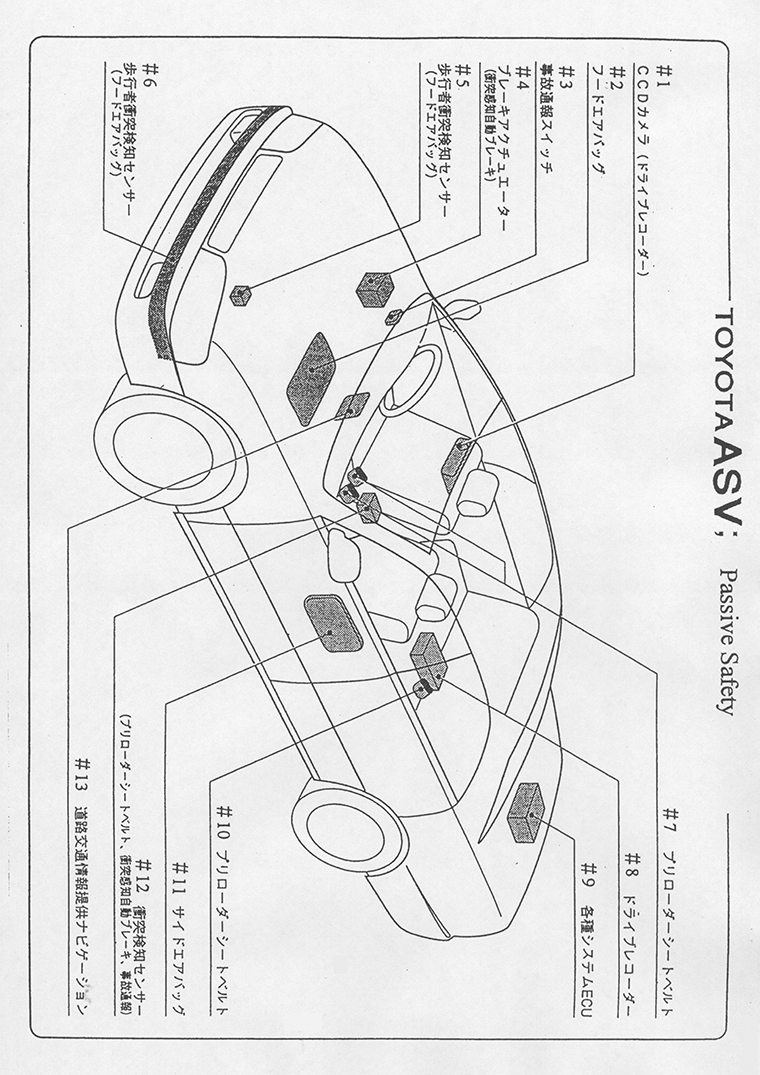
Illustration A
Toyota ASV―Passive Safety

