Apr. 14, 1997


Toyota Unveils Innovative New Recycling Technology
Makes Possible the Recycling of a Greater Number of Bumpers
Tokyo―TOYOTA MOTOR CORPORATION (TMC) announced today that, as part of its Toyota Eco-Project, it has developed jointly with the Toyota Central Research & Development Laboratories, Inc. a new technology for recycling repaired or repainted bumpers made of Toyota Super Olefin Polymer (TSOP). This technology will be introduced from the middle of this year, providing for a greater number of TSOP bumpers to be recycled into bumpers for new vehicles that are of the same quality as those made from new material.
Toyota has long considered protection of the environment to be one of its top priorities as an automobile manufacturer. The Toyota Earth Charter was announced in January 1992, followed in February 1993 by the twenty-two item Environmental Action Plan, which reaffirmed those policies set forth in the Charter. The Plan was revised in April 1996 to set new goals to replace those that had already been achieved and to further focus TMC's environmental efforts.
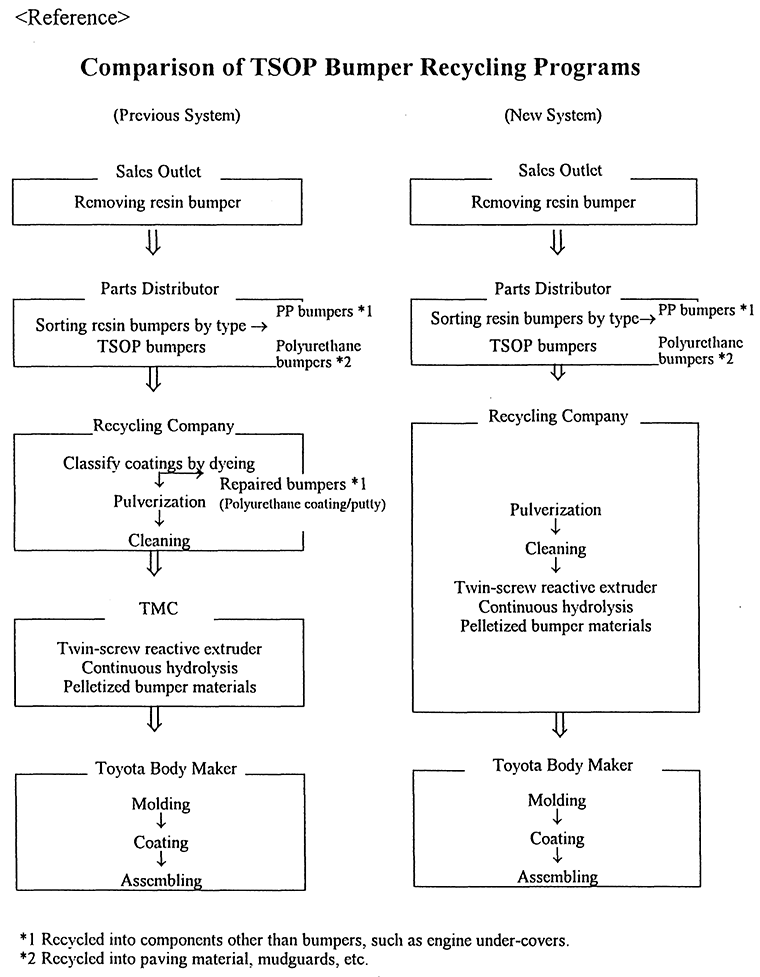
The technology announced today improves upon the existing recycling system in that it enables the chemical decomposition of after-market TSOP bumper coatings. The hydrolysis technology already in place can be used only for bumpers coated with melamine, which is the standard coating on bumpers shipped ex-factory. The new technology is revolutionary in that it also works on the putty and polyurethane coating used for repairing bumpers, which have very strong molecular bonds that cannot readily be broken down. The new technology will make the sorting of recovered TSOP bumpers unnecessary, and all recovered TSOP bumpers can be recycled into bumpers for new cars.
The new technology consists of three major processes. First is the cleaning and pulverization of the used TSOP bumpers that are collected from sales outlets. The second step is the mixing of the coatings and other elements, which have been melted and micro-dispersed by means of the newly developed amine-based coating decomposer and a twin-screw reactive extruder (using a special screw to accelerate the chemical decomposition under high temperature, high pressure conditions). The final process is the continuous pelletization of the TSOP―turning them back into usable raw materials of a quality equivalent to that of new materials―in large quantities.
Steps in Toyota Bumper Recycling Program
-
Development of easy-to-recycle material
-
- August 1991
- TSOP developed
-
-
Development of recycling technology
-
- June 1993
- Developed hydrolysis technology for coatings
-
- April 1994
- Began recycling painted TSOP factory waste material into new bumpers
-
- December 1994
- Developed simplified technology for separating after-market coated bumpers using a dyeing method
-
- May 1995
- Started recycling melamine coated TSOP bumpers recovered from sales outlets into new bumpers
-
-
Establishment of bumper collection system at sales outlets
-
- December 1991
- Began recovering bumpers from Tokyo area sales outlets through parts distributors
-
- October 1996
- Implemented bumper recovery system at sales outlets nationwide
-