Jul. 08, 1996


Toyota Recycling Technology Employed at Pilot Plant
World's First Full-Scale Shredder Residue Recycling Begins
Tokyo―TOYOTA MOTOR CORPORATION announced today the start of full-scale operations at its pilot shredder residue recycling plant, the first to apply Toyota's unique technology for recovering materials from scrapped cars and for processing the remaining material to reduce its volume. The plant is located within the Handa Plant of Toyota Metal Co., Ltd., a shredder company.
Shredder residue, conventionally disposed of in landfill sites, is the mixture of resin, rubber, and textile remaining after a car body is scrapped and the iron-based metal content is removed. At the pilot plant, sorting, reusable material extraction, and waste compacting processes have been introduced to make possible the recycling of shredder residue and efficient disposal of waste.
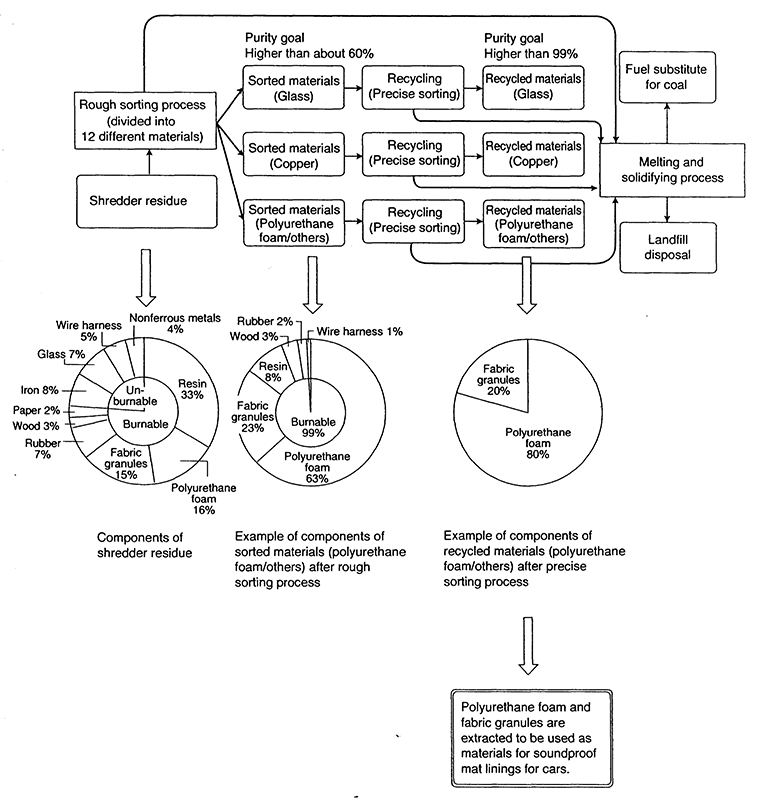
First, 17 sorting machines roughly separate the residue into 12 different materials. These are then sent through wind and gravity sorters that extract reusable portions, including high-purity polyurethane foam, fabric granules, copper, and glass.
The recycled polyurethane foam and fabric granules are used to produce soundproof mat linings for new cars, the copper for reinforcing cast aluminum parts, and the glass for reinforcing tiles used in the construction industry.
The volume of the remaining waste materials is greatly reduced by melting and solidifying them using special mixing and extraction machines. These processes enable 15% (by weight) of the shredder residue to be recycled and the waste materials to be reduced to about 20% of their original volume.
Toyota will now begin developing technology to use the remaining waste materials as a fuel substitute for coal. It is also investigating technologies for, and the economic feasibility of, further shredder residue applications, as well as uses for other recovered materials.
In 1990, Toyota established its Recycling Committee, which developed design and R&D initiatives for easily recyclable vehicles and a recycling system for resin bumpers. Toyota's goal of 90% recyclability of all vehicles by the year 2000 is being undertaken through initiatives such as the Toyota Earth Charter (formulated January 1992), and the Toyota Environmental Action Plan (formulated February 1993, revised April 1996). To help attain this goal, Toyota is engaged in a variety of technology initiatives, such as development and use of easily recyclable resin, and the development and commercialization of shredder residue applications.
The need for a large-scale reduction in shredder residue waste is widely recognized by the automobile industry. In an effort to develop and test technologies for processing materials from scrapped cars, the Japan Automobile Manufacturers Association, Inc. is developing technology to tap recyclable energy through melting and solidifying shredder residue waste or turning it into carbonized gas. Along with its own technology development, Toyota is also actively taking part in these industry-wide programs.
Conceptual Diagram of Pilot Shredder Residue Recycling Plant