Dec. 18, 1995


Toyota to Step Up Safety Equipment Improvement Plan
Installation of ABS as Standard Equipment Moved Forward
SRS Side Air Bag Installation to Start Next Summer
Tokyo―TOYOTA MOTOR CORPORATION announced today that it plans to install an antilock brake system (ABS) as standard equipment on all its passenger cars and recreational vehicles (RVs) by the end of March 1997.
Toyota has also developed a supplemental restraint system (SRS) side air bag to protect against side collisions, which will be introduced as standard equipment for a vehicle next summer and installed on about 20,000 vehicles a month from the fall. The SRS side air bag will be gradually installed on an increasingly larger number of models.
Toyota has always regarded assurance of vehicle safety as a top priority, and has long been committed to research, development, and promotion of active and passive safety technologies. Since the announcement of its car safety equipment plan in April, Toyota has focused on installing ABS and driver-side SRS air bags as standard equipment.
Toyota has already launched models equipped with ABS as standard, and ABS prices were reduced in September, resulting in an installation rate increase for passenger cars (including RVs) from 15% early this year to 35% in November.
Moreover, installation of the Vehicle Stability Control (VSC) system―an advanced safety system to help prevent lateral skidding―has commenced with the Crown Majesta.
The original plan to make ABS standard on 60% of all passenger cars and RVs by the end of 1996 has been updated by an ambitious plan to make ABS standard on all new Toyota passenger cars and RVs by the end of March 1997. Also, extra effort will be made to encourage installation of SRS side air bags.
Toyota plans to install driver-side SRS air bags as standard equipment on all passenger cars and RVs by the fall of 1996; passenger-side air bags will be offered either as standard or optional equipment for all passenger cars and RVs by the spring of 1996.
The SRS side air bag deploys instantaneously in a side collision, and together with high strength cabin and impact-energy absorbing doors, the side air bags are designed to reduce driver and front passenger chest injuries. The system's outstanding points are that it is built into the seat―assuring protection regardless of the seat's position―and the unique use of compressed argon gas for inflation.
Outline of SRS Side Air Bag System
- Structure and Trigger Process
- The SRS side air bag is triggered when the G (acceleration) sensor detects a severe side impact to the body structure of a certain magnitude.
-
- Trigger mechanism
-
- After the G sensor low in the center pillar detects a severe side collision, the built-in computer triggers bag inflation.
- The computer's trigger signal operates the inflation device, which heats and expands the gas to fill the bag as it is released.
- The side air bag, with a 12.0-liter volume, reduces impact by acting as a cushion between the passenger and the door.
- Functions and Features
- Deployment of the side air bag between the front seat occupant and the door assists the door in absorbing the side impact energy to reduce chest injury.
- Because there is less space to absorb impact energy than in a head-on collision, the triggering decision by the computer must be very short (typically 0.02 seconds from impact to complete inflation). Hence, the G sensor is placed low in the center pillar for accurate detection.
-
- The air bag is installed in the seat back rather than the door trim to
-
- Assure protection from injury regardless of the seat's position
- Enhance side-collision protection provided by the high-strength cabin and energy-absorbing door structures.
- The inflator is of a new type which heats and inflates the inflator gas mainly consisting of argon.
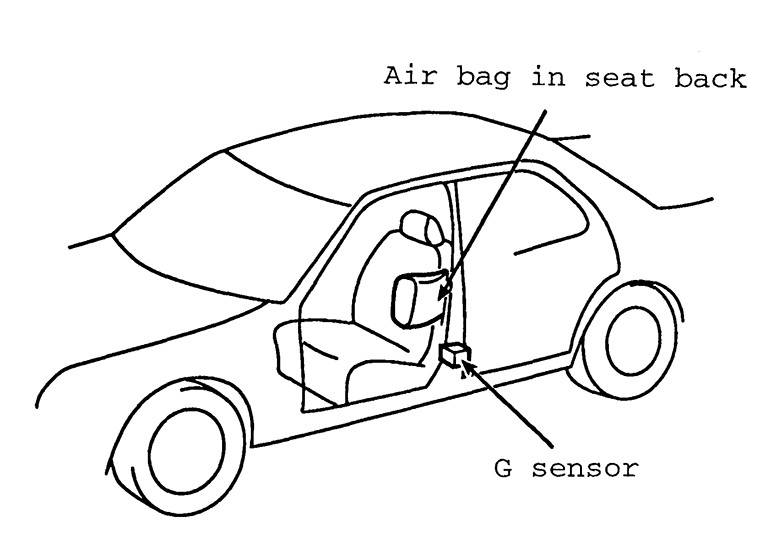
SRS Side Air Bag System
