Sep. 02, 1998


New Generation 1-liter Gasoline Engine
Achieves Low Fuel Consumption, Clean Emissions
Tokyo―TOYOTA MOTOR CORPORATION (TMC) today announced it has developed a new 1-liter gasoline engine for compact passenger cars, achieving superior fuel efficiency and clean emissions in consideration of tomorrow's environment.
The new compact, light-weight gasoline engine was developed to emit less carbon dioxide (CO2) by means of improved fuel efficiency, and to curtail carbon monoxide (CO), hydrocarbons (HC) and nitrous oxides (NOx) exhaust gas levels. Innovations such as Variable Valve Timing-intelligent (VVT-i) realize excellent power performance and the cleanest exhaust gas level in its class. This engine also meets new exhaust restrictions slated to go into effect in October 2000.
TMC plans monthly production of around 20,000 vehicles for both domestic and overseas markets, beginning early next year.
MAIN FEATURES
- Excellent Power Performance
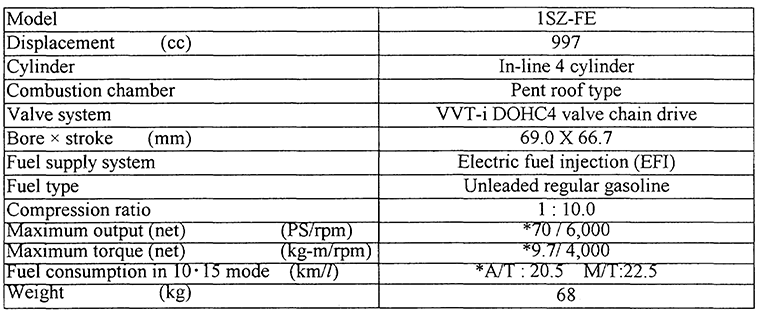
- In addition to VVT-i's continuous control mechanism that achieves optimal valve timing according to engine revolutions and load, the new gasoline engine adopts a resin intake manifold of uniform length to provide smooth torque and output at low and midrange speeds. All of these innovations combine to realize the best power performance in the 1-liter class. (Goals: Maximum output: 70PS at 6,000rpm; maximum torque: 9.7kg-m at 4,000rpm)
- Superior Fuel Efficiency
- VVT-i, compact combustion chambers, and offset crankshafts, combined with reductions in friction loss, work to improve thermal efficiency resulting in a superior fuel efficient gasoline engine that leads the 1-liter class. (Fuel efficiency goals, as measured in 10-15 test mode: 20.5km/L for automatic transmissions; 22.5km/L for manual transmissions)
- Clean Exhaust Gases
- Engine and exhaust system improvements cut environmentally-burdensome CO, HC and NOx emissions by more than 70%, even after 80,000km of use. This surpasses stringent new regulations set to go into effect October 2000.
- Extremely Quiet Operation
- Increasing the rigidity of the cylinder block, high-tensile crankshafts, and large stiffening plates improve the coupling rigidity between the cylinder block and the transmission case. These innovations, combined with the uniform length of the intake and exhaust manifolds, help control vibration and noise. The overall result is extremely quiet engine operation.
- Lightweight and Compact
- TMC's precision casting method has improved the cylinder block's dimensional and positional accuracy while cylinder wall thickness has been reduced and bore pitch decreased.
These improvements, combined with the serpentine belt layout and oil pump built into the block, made it possible to create a gasoline engine boasting an overall length matching that of a mini-vehicle power train and a 68kg weight that is the lightest in the in-line 4 cylinder 1-liter class.
MAIN TECHNOLOGIES
- VVT-i Mechanism
- Continuous control of intake valve opening and closing functions ensures optimized valve timing in every driving situation. It also improves torque, output and fuel efficiency, and decreases HC and NOx emissions.
- Offset Crankshafts
- Offsetting the center of the crankshaft in relation to the center of the cylinder block bore decreases the side forces on the piston and cylinder during combustion and expansion strokes to reduce friction loss and increase fuel efficiency.
- Resin Uniform-length Intake Manifold
- Airflow speed is increased by optimizing the shape of the intake manifold branch, thereby increasing suction inertia and pulse effect. In addition, by utilizing length long branch pipes of uniform length, torque at low and midrange speeds is increased with the application of the pulse effect. Weight is also reduced by the use of resin materials.
- Silent Chain System
- Reductions in chain noise, engine size and weight are achieved by driving the cam and oil pump using a single-stage, small-pitch silent chain.
- Serpentine Belt System
- Optimal placement of auxiliary equipment achieves a serpentine drive layout that utilizes a single belt, and also contributes to the decrease in total engine length and size.
MAIN SPECIFICATIONS