Oct. 04, 1996


Toyota Unveils Fuel Cell Electric Vehicle
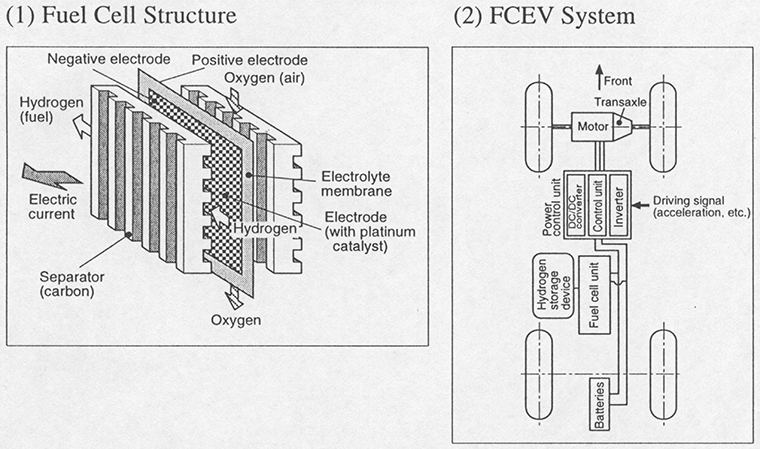
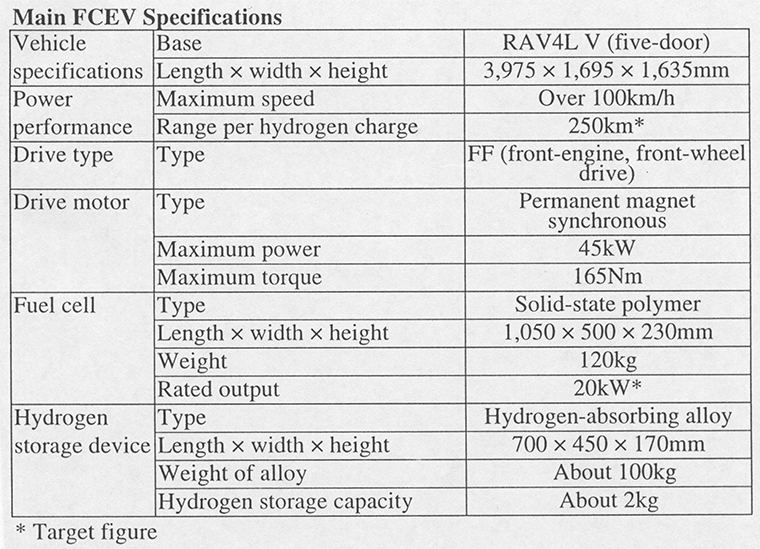
Tokyo―TOYOTA MOTOR CORPORATION (TMC) announced today that it has developed Japan's first next-generation fuel cell electric vehicle (FCEV). This new EV, based on the RAV4L V (five-door), is powered by a chemical reaction between hydrogen and oxygen within the fuel cells rather than through the combustion of fossil fuels.
Toyota began EV research in 1971 out of its concern for the environment. In line with its many technological achievements since then, TMC recently began marketing the RAV4L EV, the world's first commercialized EV powered by nickel-metal hydride batteries.
Originally developed to power space craft, fuel cells now hold the promise of wider applications. The FCEV's newly-developed fuel cell system creates energy through the reaction of hydrogen and oxygen when they are combined to create water. The energy conversion efficiency of the FCEV's fuel cell system is over 60%, two to three times that of gasoline engines. Additionally, its only by-product is clean water vapor, completely eliminating HC, CO, NOx, and CO2 emissions.
By combining Toyota's unique new fuel cell system with a high-performance hydrogen-absorbing alloy that was developed independently by TMC, the FCEV provides the following advantages
-
Compact, high-performance fuel cell system
Until now, the large size of conventional fuel cell units has made it difficult to adapt them to powering EVs. The compactness of Toyota's fuel cell system allows it to be integrated into vehicles the size of the RAV4L V.- High-Performance Hydrogen-Absorbing Alloy
-
Hydrogen-absorbing alloys, which make possible the compact and stable storage of hydrogen at ordinary temperature, are well suited for use in hydrogen storage units. Additionally, the application of alloys in such devices as heat pumps for air-conditioning units and thermal storage units is also being researched and developed.Rare-earth-based hydrogen-absorbing alloys, which are currently being used mainly in nickel-metal hydride batteries, have superior hydrogen absorption and desorption rates. However, they are handicapped by their limited hydrogen storage capacities.To reduce the size and weight of hydrogen-absorbing alloys, researchers have been studying titanium-based alloys with body-centered cubic (BCC) structures, magnesium-based alloys, and other materials that appear to have the potential to compactly store large amounts of hydrogen.
Currently, these materials are also limited because their hydrogen desorption capacity remains rather low at ordinary temperature and pressure.Toyota's independently-developed hydrogen-absorbing alloy, however, is a BCC alloy that enables both the compact storage of large amounts of hydrogen and much improved absorption and desorption at ordinary temperature and pressure.-
- Doubled Absorption and Storage
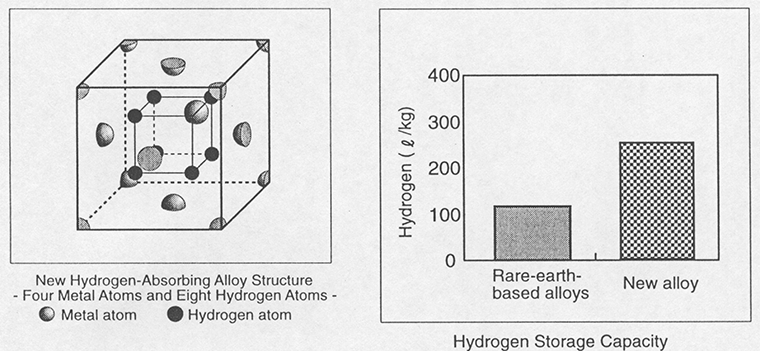
- In rare-earth-based hydrogen-absorbing alloys, a single metal atom absorbs one hydrogen atom. Toyota's new BCC alloy, in contrast, enables a single metal atom to absorb two hydrogen atoms because of the structure of the alloy molecules, thus doubling hydrogen absorption. In fact, the density of the hydrogen stored within Toyota's new alloy can reach levels even higher than that of solid-state hydrogen, which translates into the highest hydrogen absorption and storage capacity of any alloy developed thus far.
-
- Superior Desorption
- In addition, Toyota's alloy simultaneously solves the desorption problems posed by the non-rare-earth-based alloys currently being studied. Thanks to an optimum element combination ratio and a microscopically homogeneous nanometer-scale structure, it boasts unsurpassed initial activation rates and hydrogen absorption and desorption rates at normal temperature and pressure.
-
-
Alloy with doubled hydrogen storage capacity
The new hydrogen-absorbing alloy makes possible the difficult task of compactly and stably storing large amounts of hydrogen at ordinary temperature and pressure. Toyota's revolutionary alloy boasts the highest hydrogen storage capacity in the world, approximately double that of existing hydrogen-absorbing alloys.The FCEV is scheduled to participate in the 13th International Electric Vehicle Symposium (EVS-13) in Osaka starting on Sunday, October 13.Compact High-Performance Fuel Cell System