Sep. 10, 2009


TMC to Display Prius Plug-in Concept at Frankfurt Show
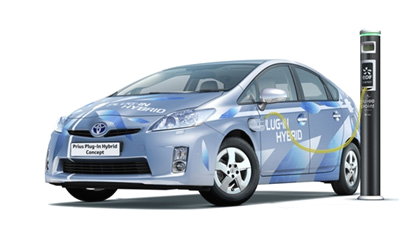
Tokyo ― TOYOTA MOTOR CORPORATION (TMC) announces it plans to display the "Prius Plug-in Hybrid Concept"―a concept vehicle that combines the benefits of CO2 emissions-reducing electrical-outlet battery charging and gasoline-electric hybrid vehicles―at the 2009 Frankfurt International Motor Show (IAA) (Frankfurt Show) to be held from September 15 to 27. The Prius Plug-in Hybrid Concept is based on the third-generation gasoline-electric Prius and is equipped with a lithium-ion battery.
A plug-in hybrid vehicle basically operates as an electric vehicle on short trips and as a conventional hybrid vehicle on longer ones. Its electric vehicle attributes mean it has a longer total cruising distance and better overall fuel efficiency than a conventional hybrid; this means lower fossil fuel consumption and, thus, reduced CO2 emissions and atmospheric pollution. But because it is a hybrid vehicle, it can run regardless of battery charge and is not completely dependent on a battery-charging infrastructure.
TMC is developing a plug-in hybrid vehicle that can be charged using external power sources (such as household electricity), based on its hybrid technology, which it has positioned as a core technology for environmentally considerate vehicles. The concept model TMC will display at the Frankfurt Show has a targeted electric-vehicle cruising range of approximately 20 kilometers on a full charge, and its targeted CO2 emissions level is below 60 grams per kilometer*.
TMC believes plug-in hybrid vehicles represent an environmentally considerate solution that can be widely applied to respond to the diversification of energy sources. As such, TMC intends to introduce approximately 500 plug-in hybrid vehicles globally―approximately: 200 in Japan, 150 in the United States, 150 in Europe (including France, the United Kingdom and Germany); primarily to fleet customers―to encourage market acceptance and promote understanding.
TMC will continue its efforts to achieve sustainable mobility by using its hybrid technologies to develop plug-in hybrid vehicles, electric vehicles and fuel-cell hybrid vehicles, which are expected to help reduce fossil fuel consumption, lower CO2 emissions and respond to the diversification of energy sources.
| Prius Plug-in Hybrid Concept Specifications |
| Length | 4,460 mm | |
| Width | 1,745 mm | |
| Height | 1,490 mm | |
| Engine | Displacement | 1,797 cc |
| Maximum output | 73 kW (99 PS)/5200 rpm | |
| Maximum torque | 142 N·m (14.5kgf·m)/4000 rpm | |
| Motor | Type | Permanent magnet synchronous motor |
| Maximum output | 60 kW (82 PS) | |
| Maximum torque | 207 N·m (21.1kgf·m) | |
| HV battery | Type | lithium-ion battery |
| CO2 emissions | below 60 g/km (target), according to the New European Driving Cycle (NEDC)* | |
| EV cruising range | approx. 20 km (target), according to the New European Driving Cycle (NEDC)* | |
| Recharging time | 100V | approx. 180 minutes (target) |
| 200V | approx. 100 minutes (target) | |
*Measured in line with new official international regulations for plug-in hybrid electric powertrains
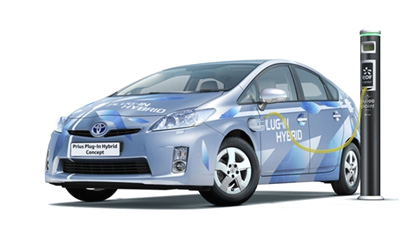
Prius Plug-in Hybrid Concept