Sep. 09, 1981


FOR DRIVERS WITH LEG HANDICAPS TOYOTA INTRODUCES
"FRIEND-MATIC" COROLLA AND SPRINTER MODELS
Also Models with Dual Accelerator Pedals for Drivers Unable to Use Right Leg
Tokyo―Toyota Motor Co., Ltd., and Toyota Motor Sales Co., Ltd., jointly announced the domestic sale beginning today of Corolla and Sprinter models with a "Friend-matic" driver-aid device that allows drivers with handicaps in both legs to drive using only their hands. Also announced were models in the same two passenger car series with dual accelerator pedals that allow persons unable to use their right leg to operate the accelerator pedal using their left leg.
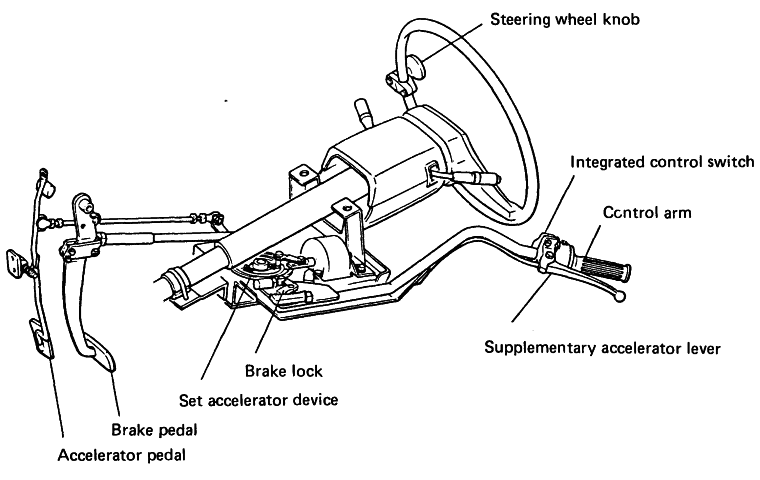
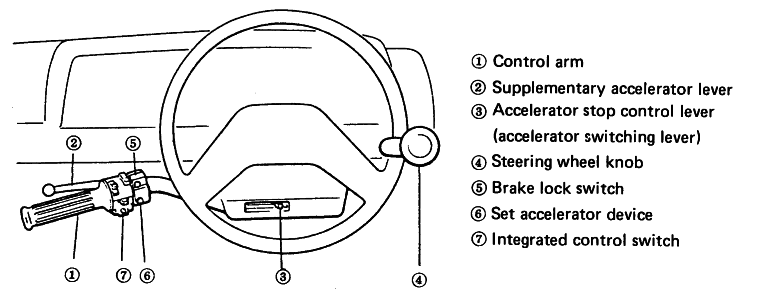
The Toyota Friend-matic has a control arm located just left of the steering wheel (see drawing) that allows the driver to control by hand the accelerating and braking operations normally controlled by foot. By pulling or pushing the control arm the driver accelerates or brakes the automobile. Models with Friend-matic can also be driven using the regular accelerator and brake pedals.
In the models with dual accelerator pedals, supplementary pedals on the left and right sides are both linked to the accelerator pedal, enabling use of either the left or right foot to operate the accelerator.
All Corolla and Sprinter models with the Friend-matic or dual accelerator pedals have automatic transmissions. A total of four Corolla and four Sprinter models―two of each with Friend-matic and two with dual accelerator pedals―were introduced today.
As of February 1980, according to a survey by the Ministry of Health and Welfare, there were 1.97 million Japanese with physical handicaps, 2.4 percent of the entire adult population (18 years or older). Of these, 1.13 million have handicaps affecting their arms or legs.
For these people to become more socially active, it is essential that they be mobile―able to move about freely―for mobility is basic to everyday life in contemporary society. Mobility for the handicapped has become one of society's urgent needs.
Toyota developed these devices in response to strong requests from physically handicapped persons, and plans eventually to have automobiles equipped with Friend-matic or dual accelerator pedals available at all its dealers. Following the Corolla (sold through "Corolla" dealers) and Sprinter ("Auto" dealers) models, Toyota will soon offer these same features in Carina ("Toyota" dealers), Corona ("Toyopet" dealers) and Cresta ("Vista" dealers) models.
Besides the passenger cars introduced today, Toyota already has on the market a "Handy-cab" version of the Hi-Ace van, which allows persons confined to wheelchairs to board or alight from the vehicle while remaining in their wheelchairs. This vehicle was put on the market in 1977, and 345 units have already been delivered to welfare groups, hospitals and facilities for handicapped persons throughout the country. Toyota engineers, moreover, are presently developing an automobile that can be driven with the feet alone, for Thalidomide victims and other persons with hand or arm handicaps.
- Note
- The models described in this release are available only in Japan.
A general outline of the Corolla and Sprinter models with Friend-matic or dual accelerator pedals follows.
- Outline of Friend-Matic FeatureThe Toyota Friend-matic device was jointly developed by Toyota Motor Co., Toyota Motor Sales Co. and Toyota Auto Body Co., on the basis of exhaustive safety and feasibility studies. Its unique and innovative Toyota technology includes the following special features (see drawing).
- For easier boarding and alighting, the Corolla and Sprinter models equipped with Friend-matic are provided with a hand grip on the driver's side, and in four-door models the passenger's seat in front is the "walk-in" type. These features also make it possible to carry a wheelchair aboard more easily. Power steering, remote-controlled fender mirrors and other equipment is standard on these models, thus also contributing to easier driving.
- For reducing fatigue from long periods of driving, the control arm has a fixed setting and the accelerator mechanism maintains a set throttle opening. This means the driver does not use his left hand as much, which reduces fatigue.
- For improved safety, an electromagnetic-type brake lock mechanism is utilized which assures that the brake is in a locked condition when the car is stopped. Safety is also improved during parking, and unnecessary use of the battery is prevented, through use of a warning buzzer that sounds if the foot brake is left "depressed" when the driver alights. In other words, the driver "depresses" the foot brake through the control arm, and if he forgets to release the foot brake after setting the hand brake and turning off the ignition before alighting, a buzzer sounds to remind him that the foot brake is still depressed. Since that means the brake lights in back are lighted, if the driver does not release the foot brake the car battery could be worn down.
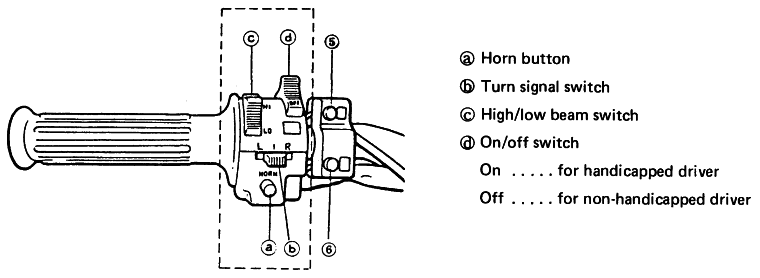
- The turn signals are fitted with an automatic cancel device which prevents the driver from turning one or the other on and then forgetting them.
Structure of Toyota Friend-Matic Unit
Details of Integrated Control Switch
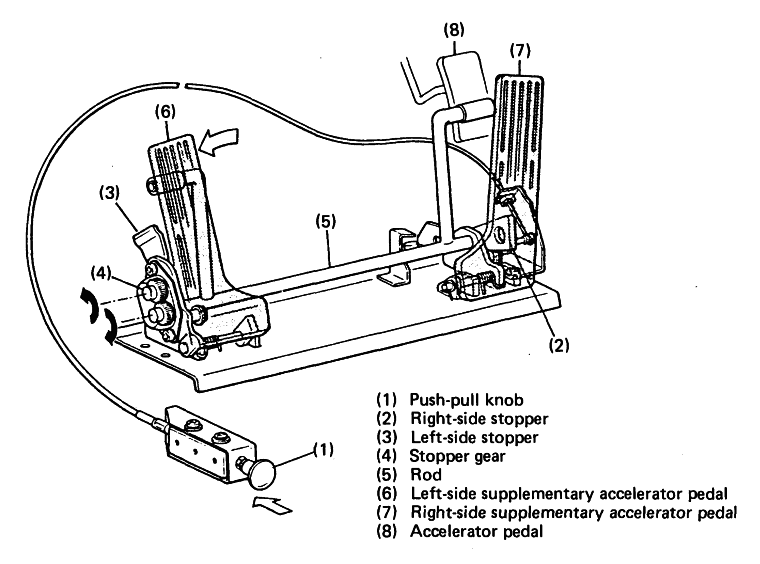
- Outline of Dual Accelerator Pedals FeatureThe dual accelerator pedals device was developed specifically for drivers unable to use their right foot. In this device, supplementary pedals are provided on the left and right sides so that the accelerator pedal can be depressed with either foot. If the driver wishes to use his left foot, he first pushes the push-pull knob (1) fixed to the side of the dashboard, which activates the stopper (2) and locks the right-side supplementary accelerator pedal (7). The left-side supplementary accelerator pedal (6) is linked to the accelerator pedal (8), making left-foot operation possible. For regular right-foot operation of the accelerator pedal, the push-pull knob (1) is pulled, which locks the left-side supplementary accelerator pedal (6) by stopper (3), releases the stopper (2) on the right-side supplementary accelerator pedal (7) and makes regular right-foot operation possible.
Dual Accelerator Pedals