

Mar. 31, 2026
Changing the Future Through Gentle Touch





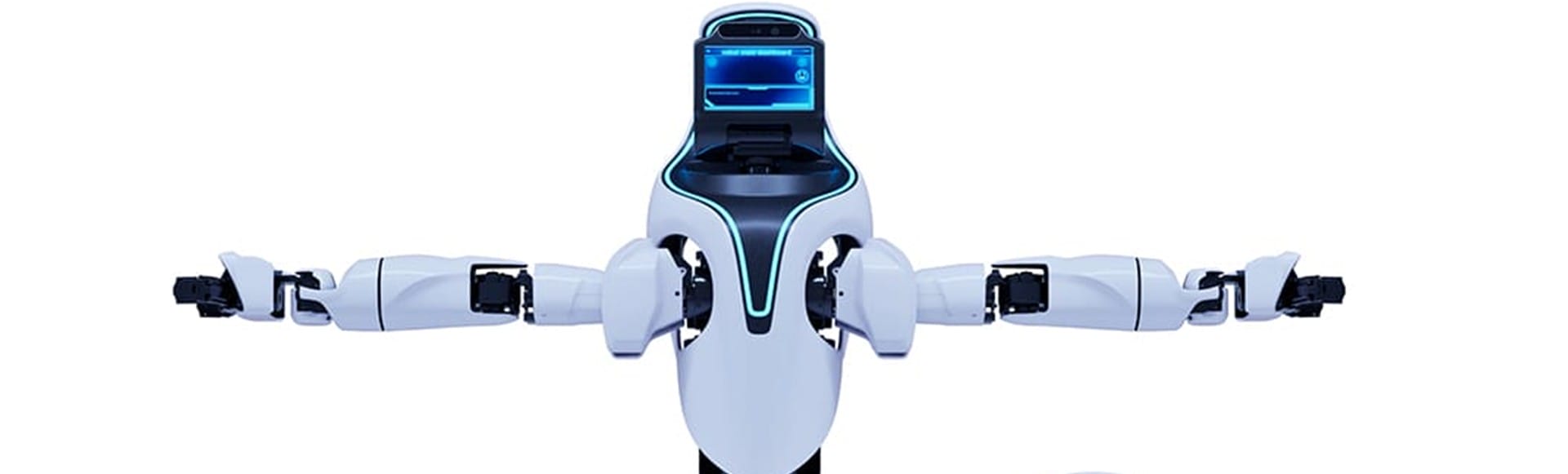
"What if you had a robot by your side―one that stayed close to you every day and grew with you, like a "true partner"?" At Toyota Motor Corporation's Frontier Research Center, we are addressing the issues of labor shortages and skill transfer. Our goal is to create a future where robots work alongside people as partners in various settings, including production sites. One of the core parts of this effort is the Human Support Robot (HSR)*1*2, a daily life support robot first unveiled in 2012. In recent years, advances in physical AI* have greatly expanded the potential for robots to acquire human-level skills by imitating and learning from human movements. However, the difficulty increases significantly as robots attempt increasingly complex tasks―such as interacting with surrounding environments and objects.
In this interview, we spoke with researcher Yamada about the challenges revealed by HSR research, the functions required for the "next mobile manipulator" derived from those findings, and the new robot, ELEY, developed to embody these capabilities.
| * | Physical AI refers to a set of technologies that enable robots to perceive the real world (the physical environment) through sensors, learn and optimize their actions according to the situation, and operate autonomously. |
|---|
Robots tend to break when "touching" objects, making necessary arms capable of gentle
- Could you tell us about the research outcomes of the HSR?
- Yamada
- As a result of our research, I believe the HSR has now become a manipulator that can move autonomously, quickly retrieve objects, and bring them back to their destination. The autonomous navigation technologies developed for HSR have been applied to the in-hospital transport robot "Potaro*3," while its object recognition, decision-making, and motion execution technologies have been utilized in the "KumiPro Robot*4," a factory robot used at Toyota Motor East Japan.
- So the outcomes of the HSR research were applied to other robot projects. What challenges became apparent through the HSR research?
- Yamada
- The HSR's arm had difficulty dissipating large external forces when performing tasks that involved contacting objects. When it attempted to grasp a target object, even a slight deviation from the intended position caused unexpected forces to act on the arm, sometimes leading to damage or malfunction. However, when working with humans or assembling objects, physical contact with the surrounding environment is unavoidable. We therefore began research on developing an arm that can gently interact with its environment*5―one that can effectively yield to external forces upon contact.
- The HSR has difficulty dissipating large external forces when performing tasks that involve contacting objects.
- First, could you explain the basic structure of conventional robots?
- Yamada
- In simple terms, a robot's basic structure consists of actuators―made up of motors and gear reducers―that function like muscles, generating torque to rotate the joints. Structural components made of materials such as aluminum act as the skeleton that supports the entire body. For a robot to interact gently with its environment, the actuators must be able to rotate freely when external forces are applied, without resisting them.
Traditionally, robot actuators combine a high speed motor with a high gear reduction ratio to increase torque while keeping the actuator compact and lightweight. However, with this structure, it was difficult to move the robot using external forces, and as a result, control was required to prevent the robot from coming into contact with its surroundings.
- Conventional robots were difficult to move with external forces. What improvements did you make to enable gentle contact with objects?
- Yamada
- Making it so a robot's arm to be easily moved by external forces helps reduce impact when making contact. The ability for an external force to rotate a joint is called backdrivability. When backdrivability is high, the robot or actuator can be moved easily by external forces, making interaction with the surrounding environment much safer and smoother.
Friction and inertia in the gear reducer are major factors that reduce backdrivability. Backdrivability is defined by Equation (1).

- Yamada
- For robot actuators, which often operate at low speeds (around 100 min-1), the effects of cogging torque and inertia become particularly significant. To achieve gentle contact, we adopted a quasi-direct-drive (QDD) actuator for the robot's joints. A QDD actuator combines a low gear reduction ratio of 10:1 or less with a high torque motor, enabling the system to maintain torque while significantly improving backdrivability. As a result, the robot can move flexibly in response to external forces and interact gently with its surrounding environment.
From the HSR to ELEY: Incorporating the lessons into a new model
- Would you say that ELEY is a continuation of the research you've described so far?
- Yamada
- Yes. Through the HSR research, we realized that as robots perform more tasks involving contact with their environment, they need not only to make gentle contact but also to maintain contact and still complete the task. When we developed an early prototype using QDD actuators to maximize backdrivability, we confirmed that it could adequately dissipate forces from the surrounding environment during tasks such as pressing a cup onto the floor or gripping and opening a door handle.
However, we still faced challenges regarding reliability during extended operation and accuracy in ensuring the arm could reliably reach target positions. To address these issues and enable contact heavy tasks to be performed in conditions closer to actual work environments―while also improving autonomy through learning―we developed ELEY as a next generation robot.
-
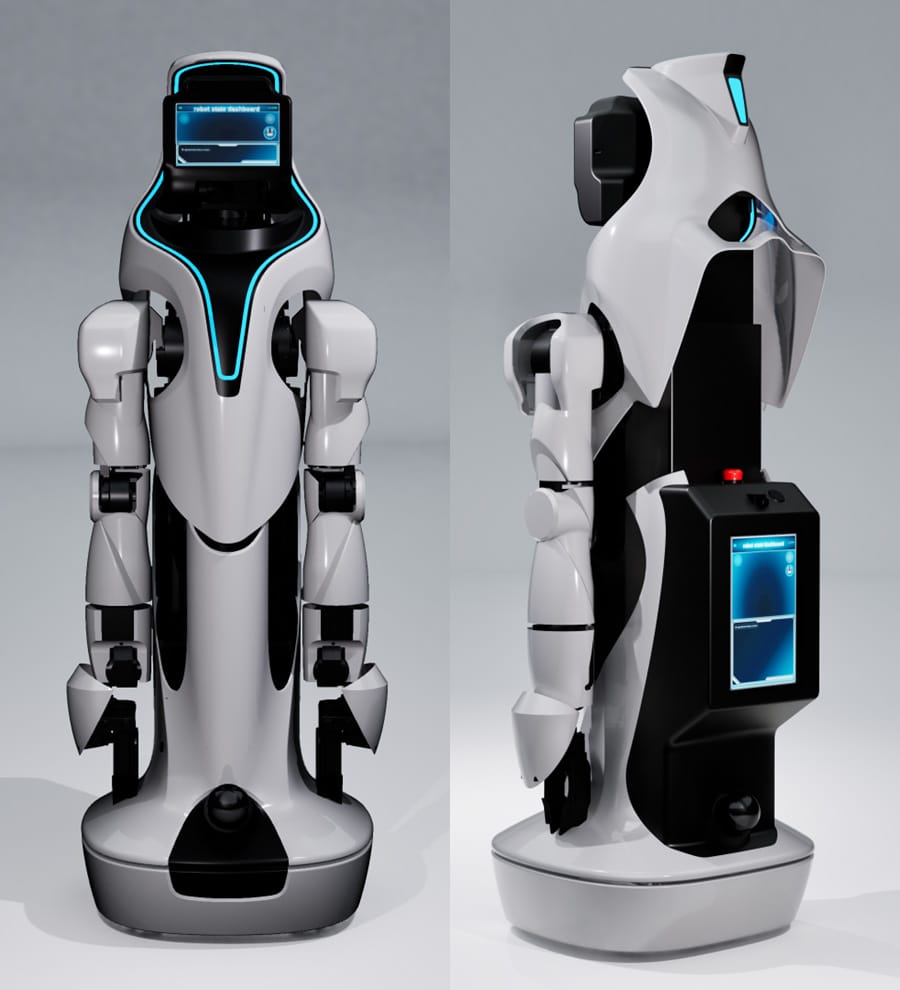
- The new robot, ELEY
ELEY is designed to interact gently with its surrounding environment.
- So ELEY embodies the concept of gentle touch. What is the origin of its name and its concept?
- Yamada
- ELEY stands for "Embodied Learning robot for Enhanced Yield," meaning a physically learning robot designed to achieve high performance and productivity. Its design emphasizes gentleness to inspire a sense of familiarity and attachment, and we chose a name that is easy to pronounce in both Japanese and English.
- What were the key points you focused on when designing ELEY's appearance and size?
- Yamada
- In recent years, advances in AI have brought about a paradigm shift―from traditional model based control to physical AI capable of learning by imitating human movements. In this era of physical AI, robots with human-like body structures can more easily mimic human motion. For this reason, we designed ELEY's joint structure to resemble that of a human. We also paid close attention to dimensions such as the joint spacing and arm thickness, designing them to match the average size of an adult Japanese male.
- ELEY even has shoulder blades doesn't it.
- Yamada
- Yes. We added a scapular axis because humans rely heavily on their shoulder blades when performing two handed tasks such as pushing objects, extending their reach, or opening a jar lid. The HSR did not have a scapular axis, which limited its range of motion. This mechanism allows ELEY to achieve a more human like range of motion and improved flexibility in practical tasks.
- Did you also focus on precision when ELEY makes contact with its surrounding environment?
- Yamada
- In earlier prototypes, one of the challenges was how accurately ELEY could move to a designated position without deviation. To address this, we switched to a direct-drive mechanism that does not use wires or resin belts, thereby improving positional accuracy. We also equipped every joint with QDD actuators, achieving high backdrivability and low inertia. As a result, the arm can be easily driven by external forces and make gentle contact with the environment.
- Collecting data for one hour, then processing it and implementing it on ELEY
- Lastly, how do you envision the future of ELEY research?
- Yamada
- There are three major challenges in ELEY that we believe are still not on par with the world's leading technologies:
(1) reliability during long hour operation,
(2) repeatability so that the end-effector can reach the same position with high precision every time, and
(3) a data infrastructure that serves as the foundation for robot learning.
Our plan is to deploy ELEY under conditions close to real production sites, convert both successes and failures into learning data, and run the improvement cycle at high speed. We will continue our research so that, in the near future, ELEY can become a partner robot that works alongside our teammates on the production site and plays an active role there.
-
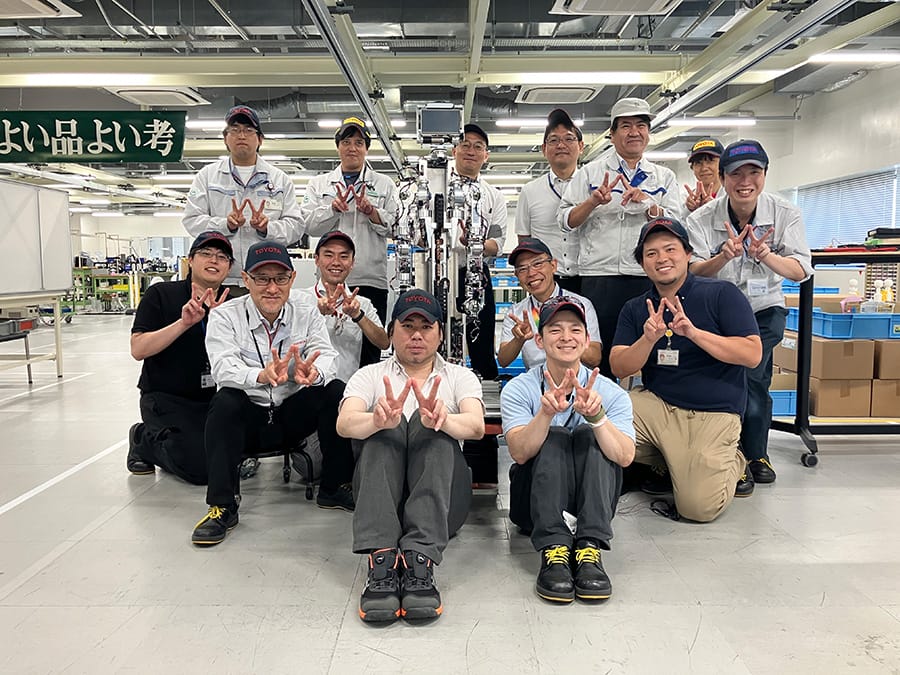
- ELEY under construction with the research team. The author is in the front row on the left.
Author
Toshihide Yamada
Factory Innovation Robotics Group, R Frontier Division, Frontier Research Center
References
Contact Information (about this article)
- Frontier Research Center
- frc_pr@mail.toyota.co.jp
RELATED CONTENT
MOST POPULAR