Feb. 02, 2026
Toyota Adds a BEV to the Pixis Van Kei Commercial Vehicle LineupEnhancing usability while advancing carbon neutrality


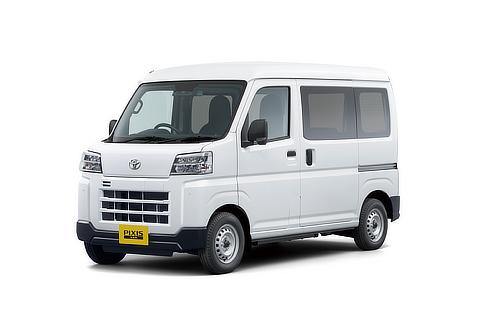
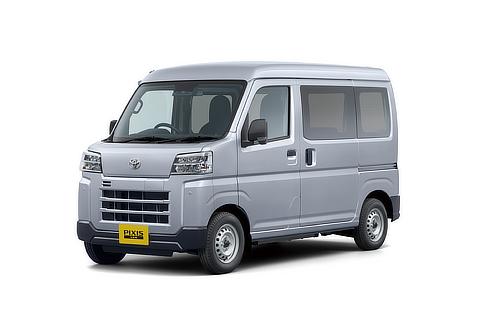
Toyota City, Japan, February 2, 2026―Toyota Motor Corporation (Toyota) has added a battery electric vehicle (BEV) to its lineup of Pixis Van*1 kei commercial vehicles in Japan, available for sale starting February 2, 2026.
-
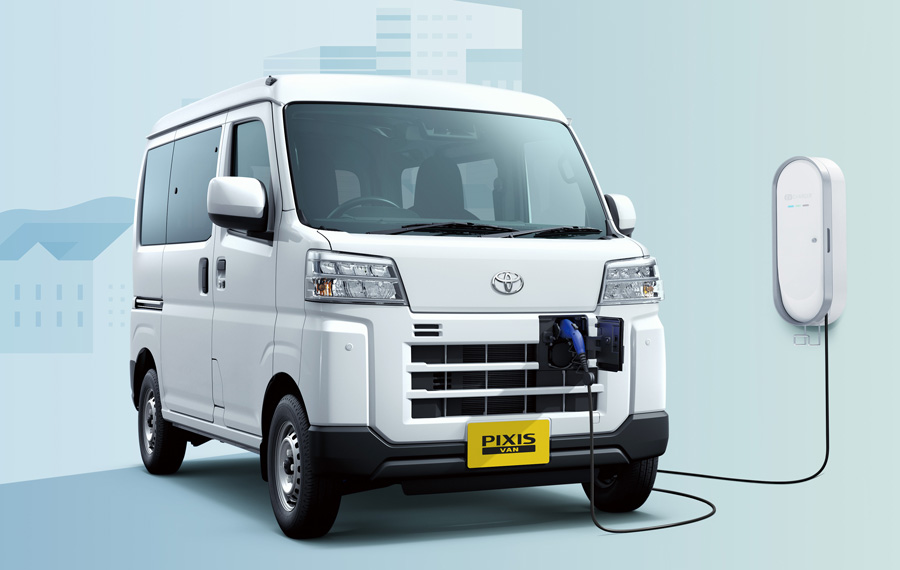
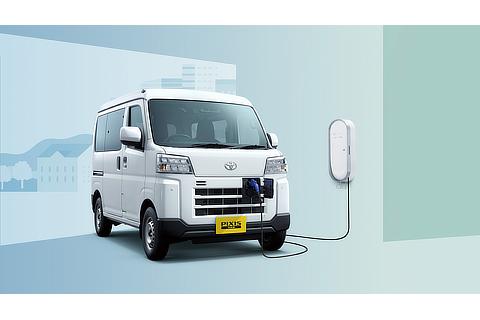
- Pixis Van Deluxe (2WD BEV) (Model with options shown)
The Pixis Van, which supports the daily mobility needs of businesses and working professionals, is now available in a new BEV model. This model aims to fully meet customer needs by retaining its excellent usability, including large cargo capacity and effortless loading, while delivering powerful, smooth, and quiet driving performance. It also achieves a cruising range of 257 km*2, enabling worry-free operation throughout a full day of deliveries or other uses.
The BEV system was jointly developed by Suzuki Motor Corporation (Suzuki), Daihatsu Motor Co., Ltd. (Daihatsu), and Toyota, utilizing Suzuki and Daihatsu's know-how in manufacturing kei vehicles and Toyota's electrification technology. Kei commercial vehicles leverage their small size to navigate narrow roads and are important in supporting last-mile logistics in Japan. They have become widespread, accounting for about 60% of the total commercial vehicle fleet in Japan (based on the number of vehicles owned, as of September 2025). Commercial Japan Partnership Technologies Corporation (CJPT)*3 also participated in the planning to pursue specifications optimal for efficient last-mile transportation.
Toyota will continue to advance efforts to practically achieve carbon neutrality through the provision of sustainable means of transportation.
| *1 | OEM vehicle based on Daihatsu's Hijet Cargo |
|---|---|
| *2 | In WLTC mode, as evaluated by the Ministry of Land, Infrastructure, Transport and Tourism |
| *3 | Established in April 2021 by Isuzu Motors Limited, Hino Motors, Ltd., and Toyota, with Suzuki and Daihatsu joining in July. It aims to accelerate the implementation and spread of CASE in society to help address various difficulties facing the transportation industry as well as help achieve a carbon-neutral society. |
Manufacturer's Suggested Retail Prices
| Grade | Occupancy | Driveline | Motor | Battery | Price* (JPY) (including consumption tax) |
|---|---|---|---|---|---|
| Deluxe | 4 | 2WD, rear-wheel drive configuration | 1CG (AC synchronous motor) | Lithium-ion | 3,146,000 |
| * | Price does not include recycling fees |
|---|
Vehicle Outline
- Comfort and dynamic performance unique to a BEV system
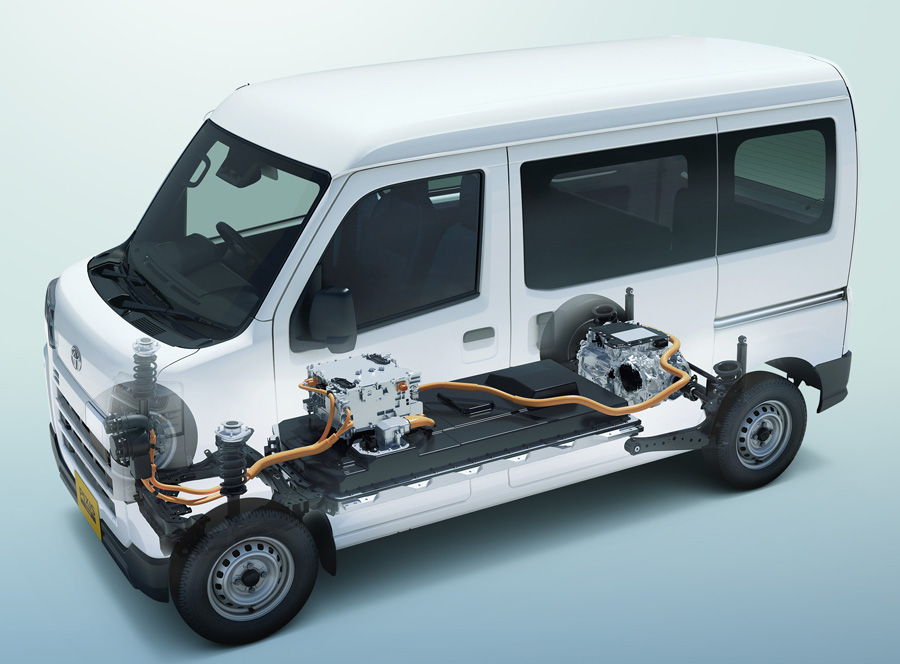
The Pixis Van BEV is equipped with the e-SMART ELECTRIC*4 BEV system, which achieves a high-level balance of quietness, acceleration, and driving stability.
- Powered by an electric motor, it offers exceptional quietness with low vibration and low noise during startup and while driving, enabling stress-free conversation inside the vehicle. It also allows for driving with consideration for the surroundings during early morning and late-night deliveries by maintaining its exceptional quietness even when stationary.
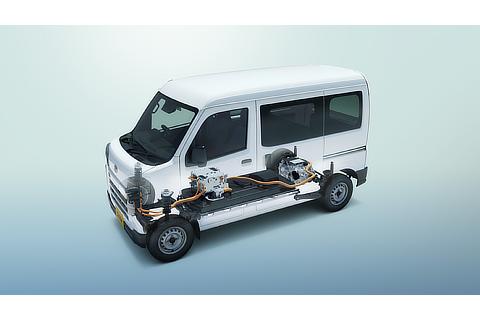
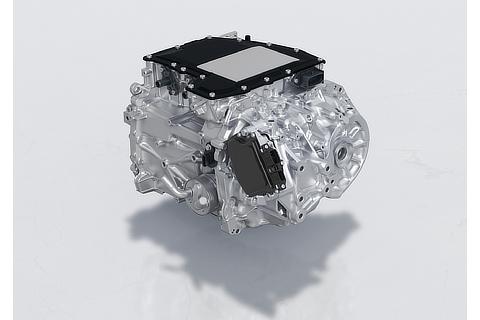
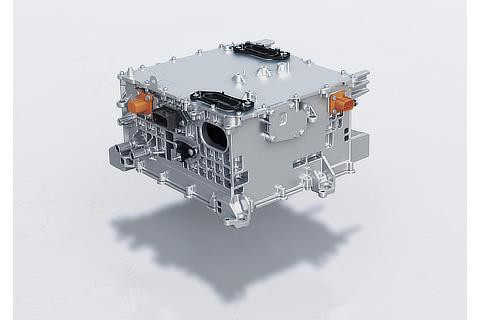
- The rear wheels feature an eAxle that integrates the motor, inverter, and reduction gear, providing an ample maximum output of 47kW and peak torque of 126 N・m from startup. This delivers powerful initial acceleration and smooth, stable performance through the strong grip of rear-wheel drive, even with heavy loads or while driving in cities with frequent stop-and-go traffic and hills, ensuring a stress-free and comfortable driving experience for the driver.
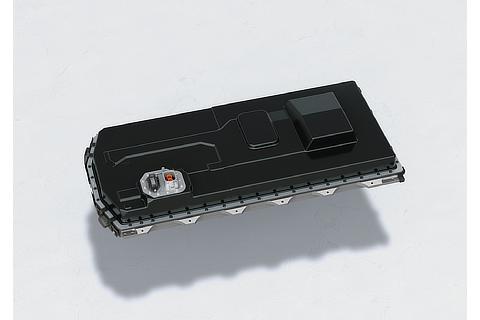
- A thin, high-capacity 36.6kWh*5 lithium-ion battery is placed under the floor to lower the center of gravity, while body rigidity is significantly enhanced through additions such as crossmembers.
- A newly designed trailing-link rigid-axle rear suspension is used to achieve both reduced unsprung weight and improved road-following performance. In addition, optimized spring rates enable a high level of both handling stability and ride comfort.
| *4 | Registered trademark of Daihatsu Motor Co., Ltd. |
|---|---|
| *5 | Calculated based on definition in United Nations Recommendations on the Transport of Dangerous Goods |
- Cruising range and charging performance that give peace of mind
- With a thin, high-capacity lithium-ion battery, it achieves a cruising range of 257 km per charge, the longest among kei commercial van BEVs*6.
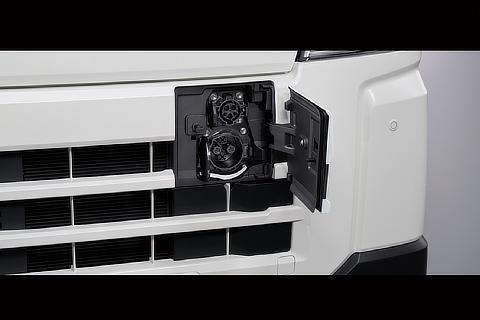
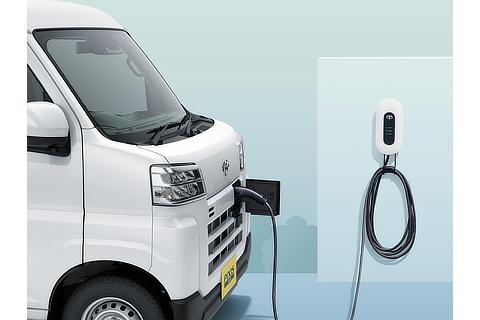
- It is equipped with a rapid charging inlet as standard for easy charging when away from home (rapid charging time is about 50 minutes*7 to reach about 80% of full charge from when the low battery light comes on) (normal charging takes about 6 hours*8 at 6kW output).
| *6 | The longest among kei commercial vehicle BEVs as of February 2026, based on Toyota research. |
|---|---|
| *7 | According to in-house measurements, when charged using a rapid charging station with an output of 50kW or higher. Charging times can vary according to the amount of remaining battery charge, battery and ambient temperatures, and the specifications of the connected power source or charging stand. |
| *8 | According to in-house measurements, when charged from when the low battery light comes on to full charge using a 6kW (30A) standard charging station with battery temperature at 25°C. Charging times can vary according to the amount of remaining battery charge, battery and ambient temperatures, and the specifications of the connected power source or charging stand. |
- Power supply performance unique to BEVs
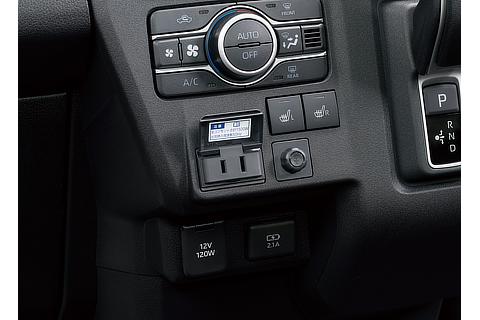
- It is equipped with a maximum 1,500W (AC 100V) external power supply function as standard, with an accessory outlet located below the instrument panel.
Allows for the use and charging of electric tools with high power consumptionEnables power supply even while driving, reducing unnecessary waiting time and significantly boosting work efficiencyMaintains exceptional quietness even when stationary to allow comfortable laptop use inside the vehicleCan also supply power during emergencies like power outages or disasters
- It is also compatible as standard with Vehicle to Home (V2H)*9, a system that allows electricity stored in the vehicle battery to be supplied to the home, enabling the vehicle to be used as a reliable storage battery during blackouts and other emergencies. By connecting the V2H device*10 (sold separately), the electricity stored in the vehicle battery can be used as household electricity.
| *9 |
|
|---|---|
| *10 | The V2H Device, sold separately, is required to transform DC electricity drawn from the rapid charging inlet (fitted with an external V2H power supply function) into AC electricity for household use. |
- Pursuing ease of use
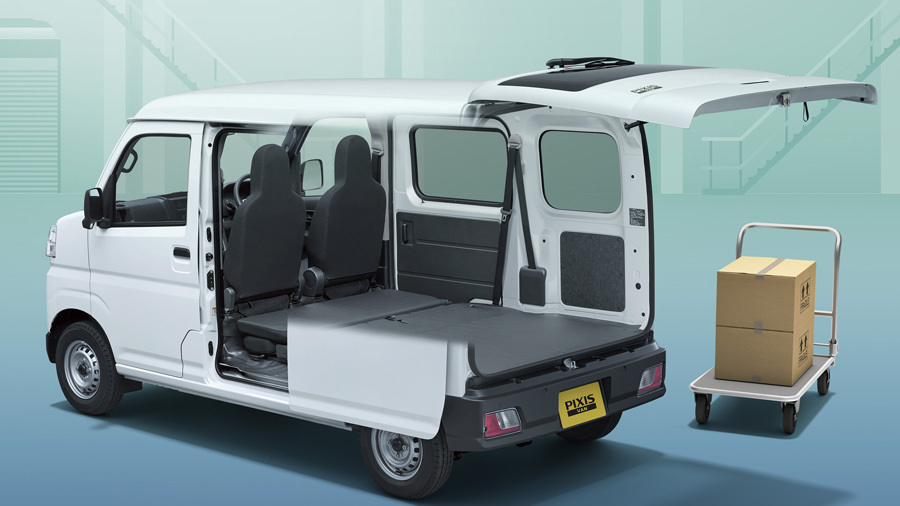
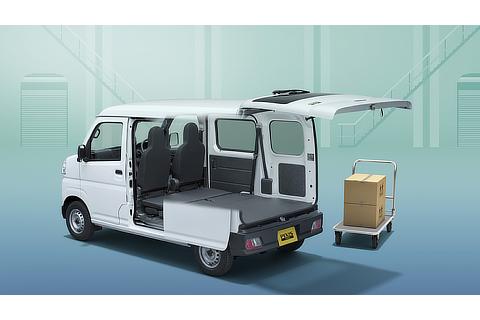
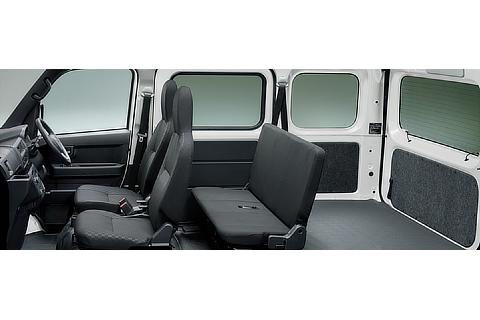
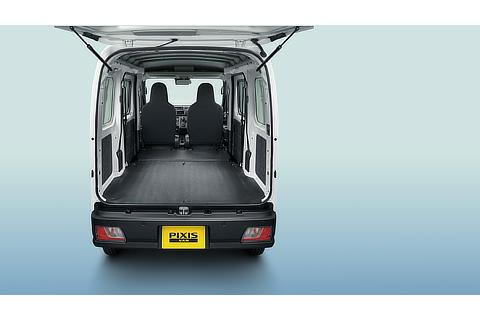
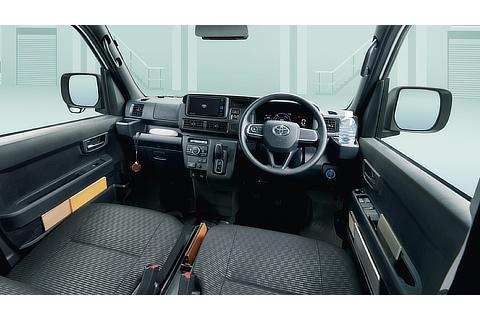
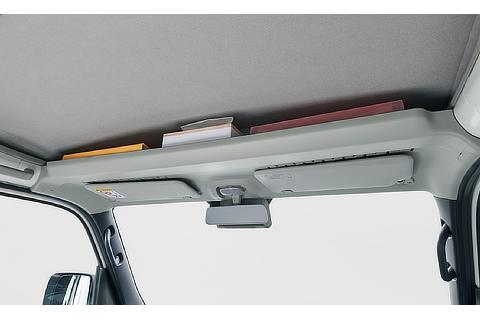
- The Pixis Van BEV offers cargo space equivalent to the gasoline model and a maximum load capacity of 350 kg. It achieves the largest loading space among kei cab-over vans*11 (cargo length 1,920 mm x width 1,270 mm x height 1,250 mm*12), along with a cargo floor height of 630 mm*13 for easy loading and unloading. It enhances ease of use as a work vehicle by adopting space-efficient overhead shelving and water-resistant full fabric seat upholstery that can be easily wiped clean.
- Energy-efficient seat heaters (driver and passenger seats) help reduce power consumption and minimize impact on cruising range. They can also be used while the vehicle is stationary.
- Usability and comfort have been enhanced with features like automatic air conditioning, an active multi-information meter that clearly displays battery level and power usage, and USB outlets for charging smartphones and other devices.
- Two package options are available, featuring easy-to-use manufacturer options that support business use.
| Prices (JPY) (including consumption tax) | ||
|---|---|---|
| Labor-saving pack*14 |
|
77,000 |
| Visibility assistance pack |
|
66,000 |
| *11 | Largest cargo length, width (with four passengers), and height as a mini cargo vehicle with a body structure lacking an engine (motor) compartment in front of the driver's seat as of February 2026, based on Toyota research. Vehicles with the same figures are available from Toyota and other manufacturers. |
|---|---|
| *12 | For two passengers, according to in-house measurements |
| *13 | According to in-house measurements |
| *14 | Registered trademark of Daihatsu Motor Co., Ltd. |
- Advanced safety and peace of mind
- It comes equipped with the latest Smart Assist*15 active safety system. The Collision Warning Function and Collision-Avoidance Support Braking Function recognize vehicles traveling straight in the oncoming lane when turning right at an intersection, as well as pedestrians crossing from the opposite direction when turning right or left at an intersection.
| *15 | Registered trademark of Daihatsu Motor Co., Ltd. |
|---|
Sales Outline
- Base sales volume for Japan
50 units per month
- Dealer options
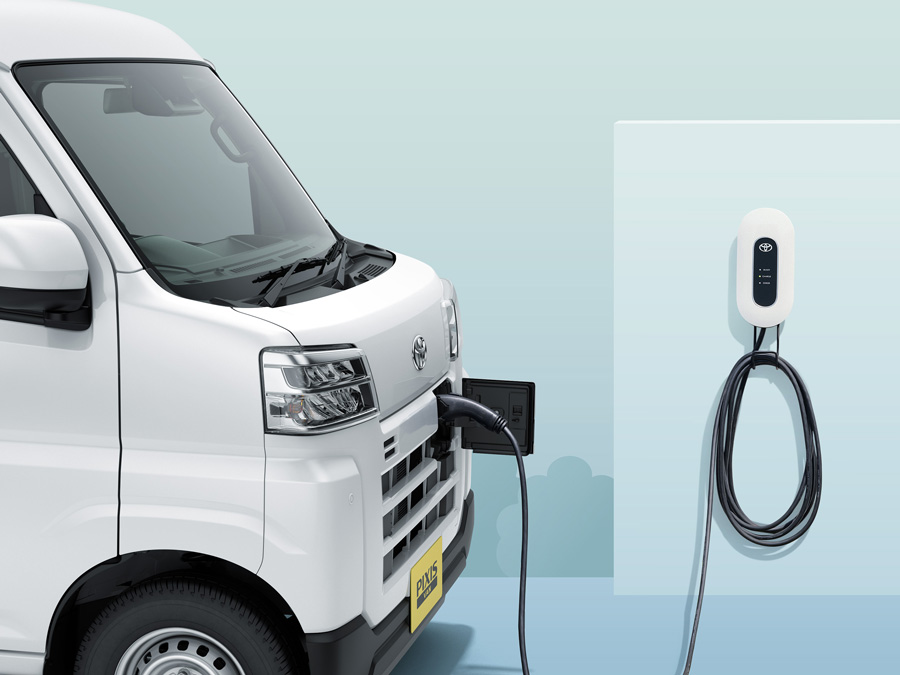
- The Toyota 6kW Charger is available as a dealer option, enabling easy charging by simply plugging the included connector into the vehicle. The integrated cable makes charging comfortable and efficient, allowing the vehicle to be charged overnight so it is ready for use by morning.
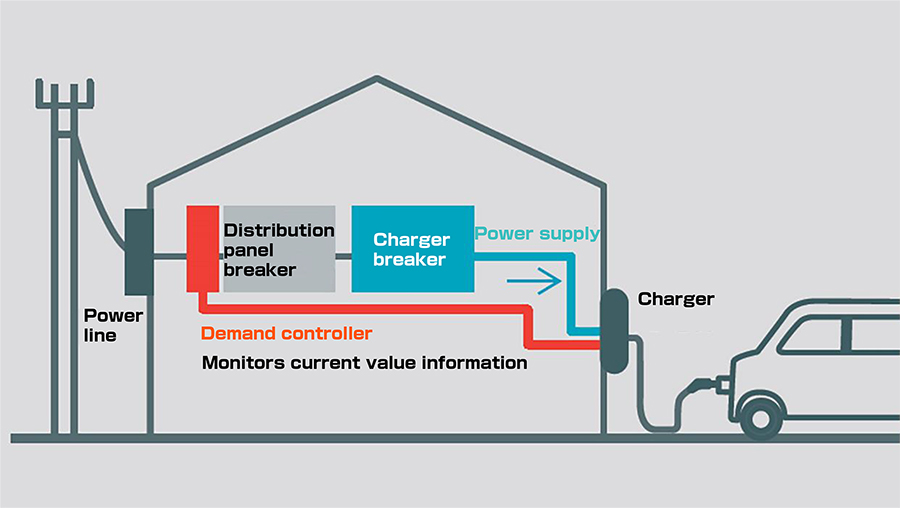
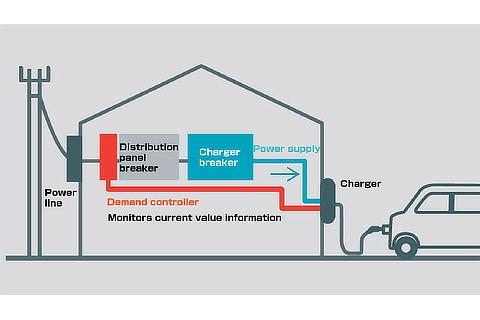
- The Toyota Charger Demand Controller is also available as a dealer option. It monitors overall household electricity usage and adjusts the charger's output in real time to prevent circuit breakers from tripping. This allows for vehicle charging with peace of mind while using home appliances, optimizes contracted power capacity (contract amperage), and helps save on monthly electricity bills.
- TEEMO charging service (available for TEEMO Lite members)
- Subscribing to Toyota's TEEMO charging service (no monthly base fee) allows access to TEEMO chargers at Toyota and Lexus dealerships*16, providing peace of mind when away from home. Charging can be initiated via a dedicated app.
| *16 | Charging at a rapid charger with an output of 50kW or higher will not change the amount of charge received. |
|---|
Production Plant
Daihatsu Motor Kyushu Co., Ltd. Oita (Nakatsu) Plant
Link to the "Pixis Van" webpage (Japanese only)

"Achieving zero, and adding new value beyond it"
As part of efforts to pass our beautiful "Home Planet" to the next generation, Toyota has identified and is helping to solve issues faced by individuals and overall society, which Toyota calls "Achieving Zero," hoping to help reduce the negative impacts caused by these issues to people and the environment to zero. Additionally, Toyota is also looking "Beyond Zero" to create and provide greater value by continuing to diligently seek ways to improve lives and society for the future.
- About Beyond Zero
- https://global.toyota/en/mobility/beyond-zero/

Toyota Motor Corporation works to develop and manufacture innovative, safe and high-quality products and services that create happiness by providing mobility for all. We believe that true achievement comes from supporting our customers, partners, employees, and the communities in which we operate. Since our founding over 80 years ago in 1937, we have applied our Guiding Principles in pursuit of a safer, greener and more inclusive society. Today, as we transform into a mobility company developing connected, automated, shared and electrified technologies, we also remain true to our Guiding Principles and many of the United Nations' Sustainable Development Goals to help realize an ever-better world, where everyone is free to move.
- SDGs Initiatives
- https://global.toyota/en/sustainability/sdgs/
SDGs goals that this project makes particular contribution to





DOWNLOADS (IMAGES)
View with caption-
-
- Pixis Van (BEV)
-
-
-
- Pixis Van (BEV)
-
-
-
- Pixis Van (BEV)
-
-
-
- Pixis Van (BEV)
-
-
-
- Pixis Van (BEV)
-
-
-
- Pixis Van (BEV)
-
-
-
- Pixis Van (BEV)
-
-
-
- Pixis Van (BEV)
-
-
-
- Pixis Van (BEV)
-
-
-
- Pixis Van (BEV)
-
-
-
- Pixis Van (BEV)
-
-
-
- Pixis Van (BEV)
-
-
-
- Pixis Van (BEV)
-
-
-
- Pixis Van (BEV)
-
-
-
- Pixis Van (BEV)
-
-
-
- Pixis Van (BEV)
-
-
-
- Pixis Van (BEV)
-
RELATED CONTENT
MOST POPULAR