


Sep. 30, 2026
Genki-KûkanTM Research Initiative (Part 7)The Immunity-Boosting Effects of Plant Fragrances



Toyota Motor Corporation (Toyota)'s Frontier Research Center and Toyota Central R&D Labs., Inc. (TCRDL) are working together on the Genki-KûkanTM Research Initiative to develop spaces that can improve people's mental and physical well-being*1-6. In Genki-KûkanTM Research Initiative (Part 3), we touched on research focused on the effects of natural air quality on humans, particularly the skin microbiome. For this installment, we spoke with research team members Soga, Ikeuchi, and Otsuki about the effects of natural air quality on the immune system.
-
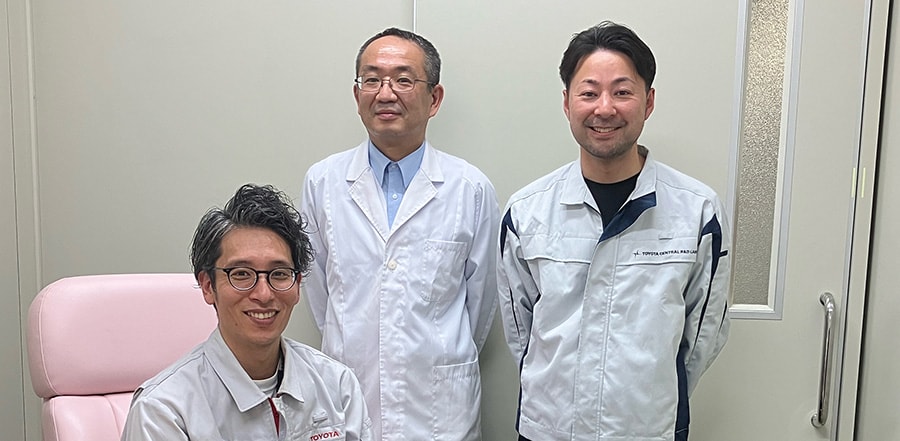
- Members we spoke with (from left):
Naoki Soga, Group Manager, Frontier Research Center, Toyota
Yozo Otsuki, Occupational Physician of R&D District, Safety & Health Promotion Div., Toyota
Akinori Ikeuchi, Leading Researcher, Bio-Inspired Research Domain, TCRDL
- What led the team to focus on immunity in Genki-KûkanTM research?
- Soga
- Research on the effects of nature on humans often focuses on visual stimuli―such as the sight of greenery―as the primary input. However, in Genki-KûkanTM research, we are also advancing studies that capture the power of "invisible nature," such as air quality (microbiota and chemical substances in the air), from a biological perspective.
- Ikeuchi
- Interestingly, earlier studies*7 have reported that exposure to natural environments, such as forest bathing, enhances the activity of Natural Killer (NK) cells, a type of immune cell. Plant-derived chemical substances (plant chemosignals, hereafter "plant CS") are thought to be one factor behind this, and we believed this could be a key clue for verifying the value of the natural air quality that Genki-KûkanTM research aims for.
- Could you explain the relationship between immunity and NK cells in a bit more detail?
- Soga
- The human immune system is broadly divided into "innate immunity" and "acquired immunity." Innate immunity is the "first-line" defense mechanism in which immune cells rapidly respond to and eliminate pathogens such as viruses and bacteria that have entered the body. Acquired immunity is a system that learns and remembers information about invading pathogens passed on by cells involved in innate immunity, using that stored memory to deal with them specifically in future exposures―a mechanism that vaccines utilize.
-
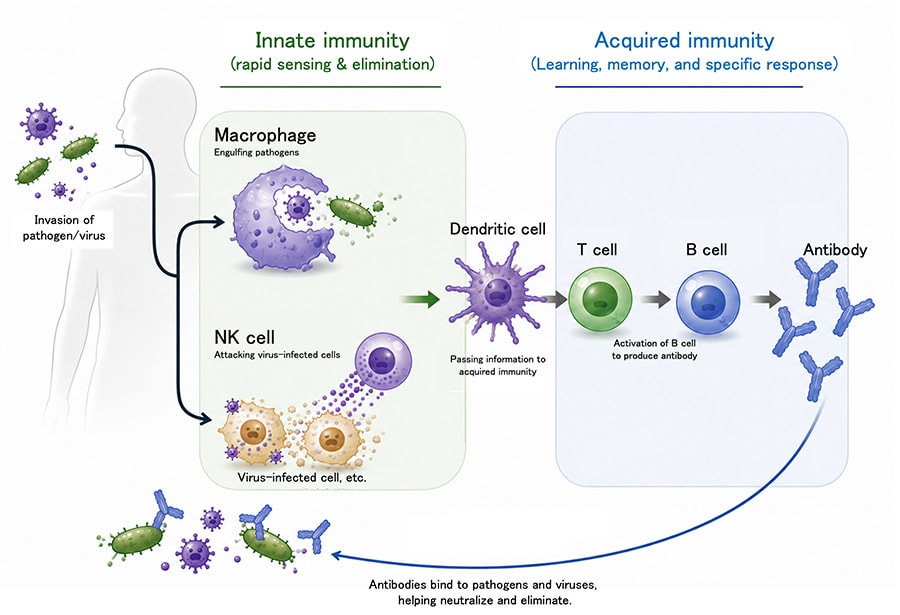
- Figure 1: Overview of the Human Immune System
- Otsuki
- Various pathogens exist around us, and we live our lives fighting off pathogens that enter our bodies to prevent infection. In other words, for us to stay healthy, it is essential that innate immunity functions properly. Within innate immunity, NK cells constantly patrol the body to find, attack, and eliminate abnormal cells, such as virus-infected cells or tumor cells. The term "immunity" frequently heard during the COVID-19 pandemic often refers to this activity of NK cells to destroy cancer cells (cytotoxic activity).
- How do you measure the cytotoxic activity of NK cells? It sounds quite difficult, but did you use any specific techniques?
- Otsuki
- Generally, cytotoxic activity is evaluated in a test tube by mixing cancer cells with blood cells obtained from a blood draw. Because NK cells in the blood sample attack target cancer cells, the number of cancer cells destroyed within a certain period is treated as the cytotoxic activity of NK cells.
- Ikeuchi
- However, blood contains various other cells besides NK cells, and NK cell counts vary by individual and day. Therefore, simply evaluating the number of destroyed cancer cells does not reveal whether the cytotoxic activity of individual NK cells has changed, or if the number of NK cells itself has changed. Since we wanted to evaluate the cytotoxic activity of individual NK cells, we needed to refine the standard evaluation system.
- Soga
- Therefore, we measured how many NK cells were present in the blood sample and calculated the cytotoxic activity per individual NK cell (NK cell activity). Measuring this NK cell activity allowed us to evaluate changes in NK cell capacity with much higher precision.
- How much should NK cell activity increase for it to be beneficial?
- Ikeuchi
- The activity of cells in the living body varies greatly among individuals and fluctuates depending on the time of day blood is drawn. For this reason, we could not find prior studies on the exact level of NK cell activity that is ideal. Therefore, by fixing the blood collection time and continuously tracking NK cell activity 2 to 3 times a month over a year, we investigated the degree of fluctuation between "good days" and "bad days." As a result, we found that while the average value of NK cell activity varies among individuals, the degree of fluctuation remains at approximately ±18% regardless of the person (Figure 2).
-
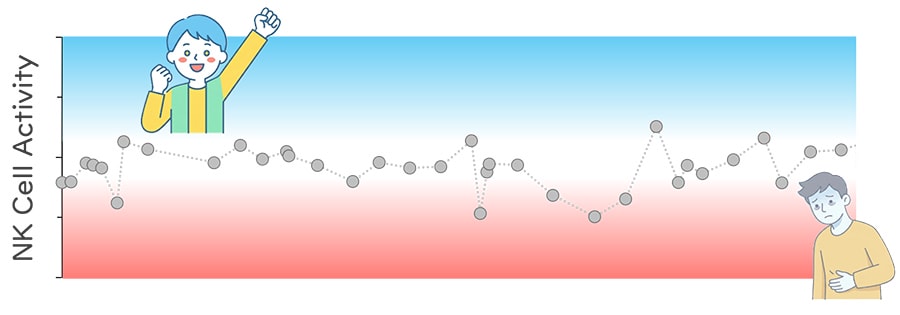
- Figure 2: Daily Fluctuations in NK Cell Activity
Daily fluctuations in NK cell activity of one subject over the course of a year
- Which plant CS have a positive effect on NK cell activity?
- Soga
- Previous research reported that plant CS derived from several types of trees, such as Japanese cypress (hinoki), may enhance NK cell activity*7. We therefore mixed dozens of different plant CS compounds individually with NK cells in test tubes to evaluate the resulting NK cell activity.
-
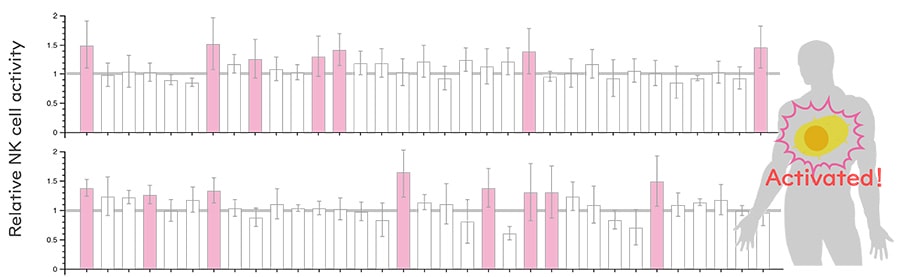
- Figure 3: Screening of Plant CS Affecting NK Cell Activity
Red bars indicate plant CS for which a statistically significant increase in NK cell activity was confirmed (p<0.05)
- Ikeuchi
- Surprisingly, we found that more than 10 types of plant CS had a positive impact on NK cells. To investigate whether these truly have a beneficial effect on humans, we decided to conduct a human trial using clary sage*8, which showed the highest efficacy.
- What kind of experiment did you use to evaluate the effects of clary sage plant CS on humans?
- Soga
- To evaluate effects in humans, we needed an experimental setup that allowed subjects to continuously inhale the plant CS throughout the testing period. Therefore, we used face masks so that subjects could inhale them anywhere, at any time of daily life. We conducted trials under two conditions―with and without applying plant CS to the mask―and examined how much NK cell activity changed between before wearing the mask (pre-inhalation) and the following day after wearing it (post-inhalation).
- Ikeuchi
- In a study conducted with 13 male and female participants, no change was observed when plant CS was not inhaled, whereas NK cell activity increased by 20% when plant CS was inhaled (Figure 4)*9.
-
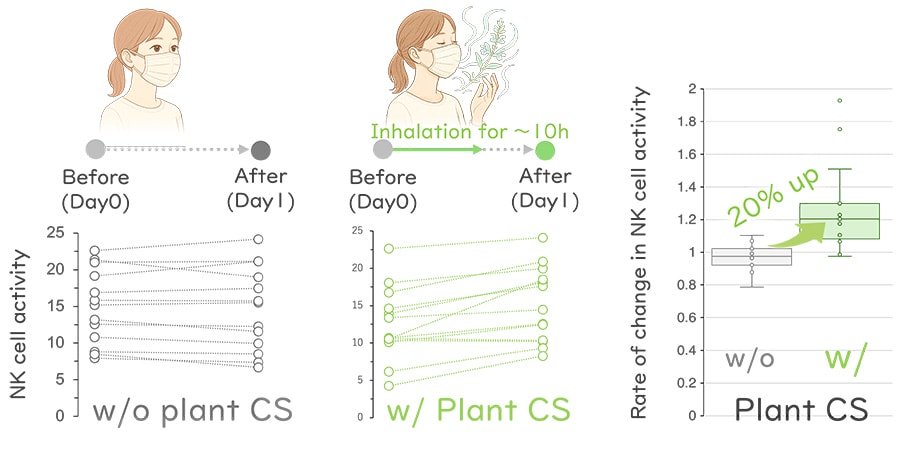
- Figure 4: Changes in NK Cell Activity Following Plant CS Inhalation
- Otsuki
- It is interesting that the 20% increase obtained this time is roughly equivalent to the range of daily fluctuations in NK cell activity. In our daily lives, we experience good days and bad days; in this study, inhaling plant CS appeared to have a mild effect, helping the body maintain or regain a healthy state. We feel these results strongly align with the concept of Genki-KûkanTM research, which aims to enhance physical and mental well-being.
- Please tell us about the future of this research.
- Ikeuchi
- As explained in Part 3, some plant CS compounds also have the effect of suppressing the growth of pathogenic bacteria on the skin. We believe the core strength of Genki-KûkanTM research lies in evaluating nature's power through its effects on the skin microbiome and immunity, and using those findings to create spaces. We aim to create a "Genki-KûkanTM" space where simply staying in an environment infused with a combination of beneficial plant CS helps promote overall physical and mental well-being.
- Soga
- Today, we presented the effects of plant CS, which is one element of natural air quality. Moving forward, we would like to investigate how airborne microbiota―another key component of air quality introduced in Part 2―affects immunity, and in the future, we hope to realize spaces that implement natural air quality.

Message from Joint Research Partner Dr. Takeo Saito (Fujita Health University)
Living organisms, including humans, possess mechanisms to maintain internal stability even when the external environment changes. This mechanism is maintained through systems such as the autonomic nervous system, hormones, and immunity. However, if the body fails to respond properly to external stimuli and these systems do not function smoothly, physical discomfort or illness occurs. In truth, we still do not understand much about how stimuli from the external environment specifically affect our bodies. This is precisely why accumulating data on "how our surrounding environment brings about changes in our bodies," as done in this study, serves as an important clue to understanding "what kind of environment is necessary" for us to remain Genki (healthy and energized).
Associate Professor, Department of Psychiatry, School of Medicine, Fujita Health University / T-CaRS Group, Human Resources Division, Toyota
References
Contact Information (about this article)
- Frontier Research Center
- frc_pr@mail.toyota.co.jp
RELATED CONTENT
MOST POPULAR