


Aim
- Reduce the environmental footprint and contribute to the sustainable development of society and the world throughout all areas of our business activities.
- Build close, cooperative relationships with a wide spectrum of individuals and organizations involved in environmental preservation.
Initiative
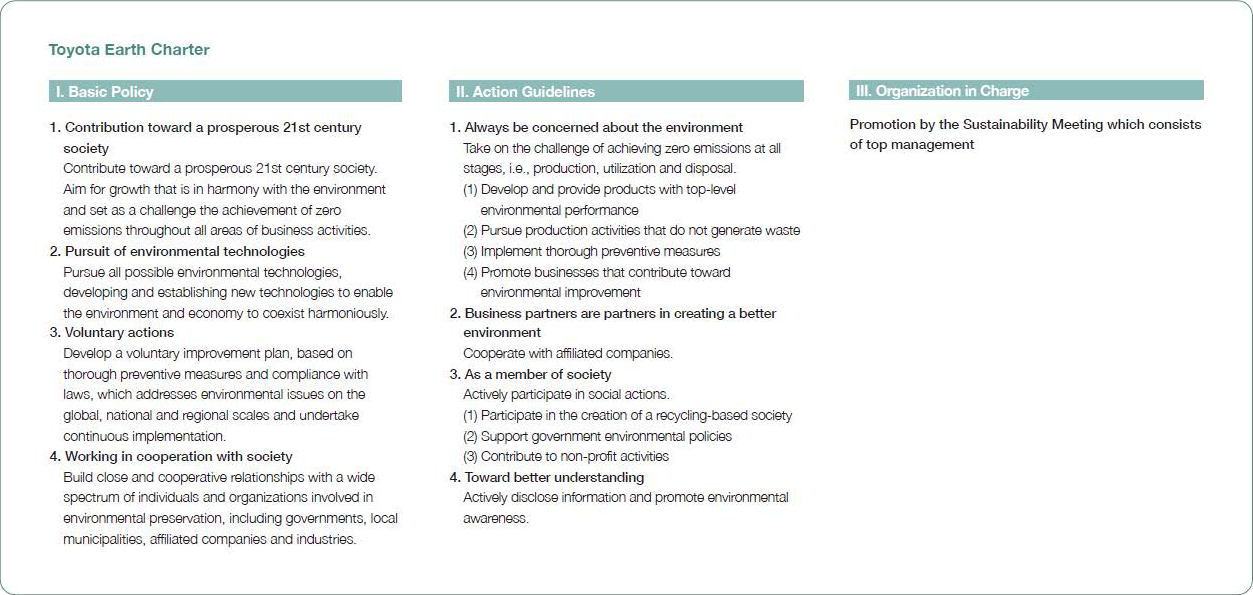
Toyota Earth Charter
- Toyota has continuously promoted environmental initiatives since the 1960s.
- In 1992, Toyota established the Toyota Earth Charter alongside the Guiding Principles at Toyota, which articulates the kind of company Toyota seeks to be.
- It was established to concretely implement the Guiding Principles at Toyota: "Dedicate our business to providing clean and safe products and to enhancing the quality of life everywhere through all of our activities."
- We revised the Toyota Earth Charter in 2000 to incorporate perspectives aligned with the demands of the times, such as the challenge of achieving zero emissions and participating in creating a recycling-based society.
- In 2020, Toyota established the Sustainability Fundamental Policy, which clearly defines our approach to sustainability management to achieve Toyota's mission of "Producing Happiness for All," and positioned it as a relevant policy to the Toyota Earth Charter.
- We regard climate change and all environmental issues as our materiality (key issues), and we will continue our efforts to contribute to the sustainable development of each region through global Toyota.
Toyota Earth Charter
Toyota established the Toyota Earth Charter in 1992 and promoting environmental initiatives.
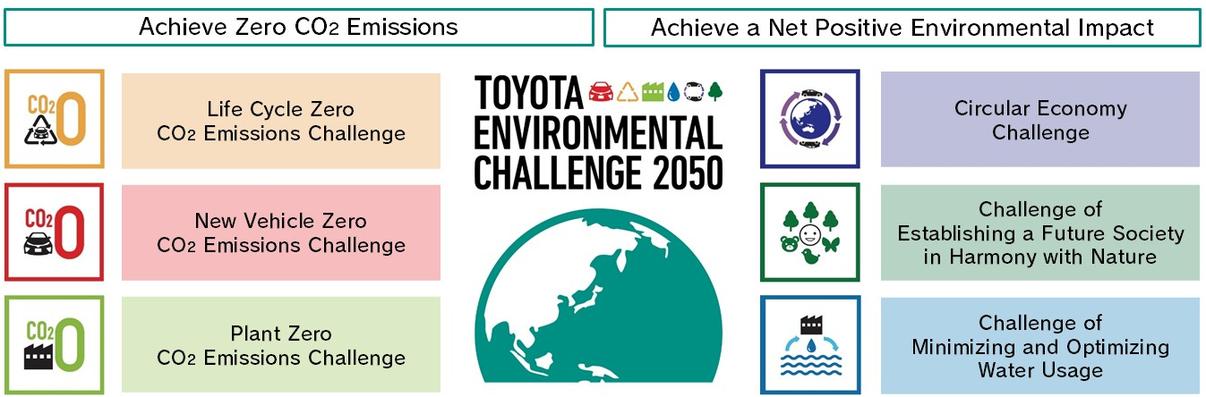
Toyota Environmental Challenge 2050
Toyota announced the Toyota Environmental Challenge 2050 in 2015.
In order to address global environmental issues such as climate change, water shortage, resource depletion and loss of biodiversity, Toyota is promoting measures based on these six challenges, aiming to reduce the negative environmental impacts of manufacturing and driving vehicles as close to zero as possible and to make net positive impacts on society.
Initiatives
Toyota is committed to reducing its environmental impact and contributing to the sustainable development of society and the Earth through all areas of its business activities. We will promote initiatives to cope with climate change, to contribute to resource recycling, and to coexist in harmony with nature.
-
-
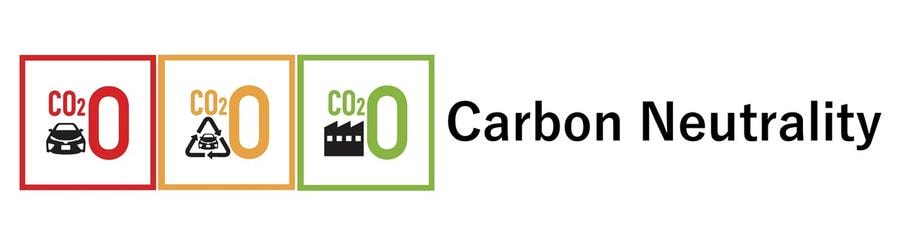
- Through contributing to achieving carbon neutrality, aim to establish a sustainable society in harmony with nature.
-
-
-
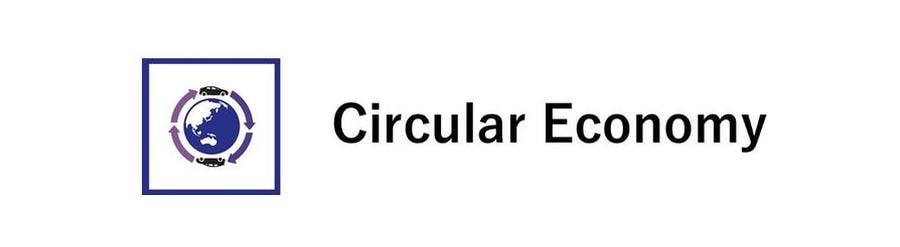
- Building a sustainable global environment and society by increasing the reuse rate of precious, limited resources.
-
-
-
- Aim to create a society in harmony with nature by promoting biodiversity conservation activities through collaboration with many stakeholders.
-
Toyota's Perspective on Public Policy
Toyota's mission, as defined by the Toyota Philosophy, is "Producing Happiness for All", and the vision is "Creating Mobility for All". We have always been committed to contribute to the overall good, so our approach to business is in line with the vision of the 17 Sustainable Development Goals (SDGs). Our perspective on public policy flows from our desire to do good for society.
The role of government and public policy is critical to helping reduce the effects of climate change and promote expansion of advanced technology vehicles around the world. Toyota seeks to ensure that public policy, societal needs, technology development, and consumer needs are aligned to the greatest extent possible.
As a member of society in the countries and regions in which we operate, we believe it's a privilege and a responsibility to contribute to public policy by sharing our technical and consumer knowledge, our vision and our views. Toyota does this transparently and always in full accordance with the spirit and letter of the law. We have positive relationships with governments and their administrative agencies, regulators, mainstream major political parties, non-profit organizations, local communities, customers, dealers, suppliers, and employees. We show respect to all, consistent with a core company belief and therefore hope to become a company that is respected and welcomed by all.
Contributing to society and public policy means that Toyota places a high priority on participating and influencing activities through industry and other associations. For example, many Toyota executives and employees are currently participating in various associations across the globe and are involved in contributing to their public policy advocacy.
Toyota's Views on Climate Public Policies
We have summarized our views on key climate related policies, our views on public policies, and the industry associations to which we belong. Toyota does so to be more transparent about our activities, to build and increase trust with the public, and to further strengthen cooperation between all stakeholders.
Validation and approval of Toyota's emissions reduction targets by the Science Based Targets initiative (SBTi*1)
Toyota's emissions reduction targets for Scope 1 and 2 and Scope 3 Category 11*2 were validated and approved*3 by SBTi in September 2022 as follows:
| Emissions | Target year | Base year | Reduction rate | Validation / Approval class | |
|---|---|---|---|---|---|
| Scope 1 and 2 | 2035 | 2019 | 68% | 1.5℃ | |
| Scope 3 Category 11 (emission intensity) | |||||
| Passenger light duty vehicles and light commercial vehicles | 2030 | 33.3% | Well Below 2℃ | ||
| Medium and heavy freight trucks | 11.6% | ||||
| *1 |
|
|---|---|
| *2 |
|
| *3 |
|
Related Information
-
-
- Sustainability Data Book
- This data book summarizes Toyota's sustainability policy, initiatives, and activities of previous year.
-